This post serves as both a movie review and a general musing on a number of subjects spurred by extremely late night and sleep-deprived thinkings. Plural. The movie Elizabethtown is a really awesomely fantastic piece of cinema. It stars both Kirsten Dunst and Orlando Bloom, and follows the story of Drew (Bloom) returning to his familial roots on the eve of his father's death and following a monumental professional failure on his part. Along the way he meets the quirky and unendingly optimistic Claire (Dunst) and he discovers the meaning of family, of connections, and most importantly the value of embracing and living life. Elizabethtown is a deeply flawed movie on many fronts, but it's a beautiful collision of imperfection that in and of itself is in fact perfect. Both Dunst and Bloom demonstrate a unique ability to completely miss the subtlety of their characters, yet somehow in those exact failures they create immensely entertaining people who, while in no way resembling real humans, serve as wonderful cyphers for bigger commentaries on the plot and life. I think it's the writing that goes a long way to salvage what I categorize as missteps in the lead performances. For instance, Drew is a decent guy who made a gigantic mistake and has screwy priorities. Orlando Bloom seems to lack the subtlety needed to portray externally a man who has been ruined professionally, has no real friends, and has recently lost a father whom he actually did care very much about. All of this is of course volleyed between his internal process and the shocks of being surrounded by a loving yet insane family (though 'loving' and 'insane' seem redundant when mentioning family). You never get the sense that Drew is experiencing any of this, yet you find yourself willingly filling in the blanks. Bloom succeeds in playing a man out of his comfort zone going with the punches for better or worse. Whether this is a result of Bloom having to ape an American accent (of which he ranks not the best but also not the worst -- see the Playstation 3 game Heavy Rain for the WORST American accents ever) or the fact that he's an Irishman in the American South is irrelevant. He's very likable, it works, and you relate. Kirsten Dunst on the other hand ends up making a character who seems like she should be at least mildly believable into the most cool, cute, and IMAGINARY figure in the movie. I think the main problem here is that Dunst plays Claire with absolutely no vulnerability -- something that in reality a person like Claire would be rife with. Still, you can't help but be drawn to her and find yourself smiling and wishing that a girl like that would come down from space on her unicorn (because she's imaginary) and set straight all of the issues in your life.
The most successful aspect of Elizabethtown is its overall tone. The film is dripping with the warmness of family and friends, the texture of the Southern States, the beautiful calamity of being lost in life and connecting with someone on a deep level, and the joy of being alive. Like almost every aspect of this movie, the tone succeeds despite itself. Elizabethtown begins as a bleak look into a man with nothing to lose's life. From here it feels like it does not know whether it intends to be dark comedy, slice-of-life storytelling, over-the-top pastiche, heartwarming, or revelatory. Despite this schizophrenia, the film again mashes into a wonderful canvas of emotion and confusion that while perhaps not narratively effective hearkens to a truly analogous version of how life can sometimes feel. This is all a fancy way of saying that I don't necessarily know why Elizabethtown resonates so resoundingly with me, but it certainly does. The movie is only helped by one of the most appropriate and effective soundtracks since Garden State. Seriously, go buy (download) it and take a drive somewhere. Beautiful.
The most charming thing Elizabethtown does is remain unendingly positive. It shows that even in the face of something as terrible as the death of a loved one, the ability to come together with the people you love and who love you is more powerful than any tragedy. And this is true both in life and this film. A family is a thing that surrounds you when you're hurt, and even though it can't necessarily heal you it allows you to be safe and deal with it all safe from the pressures of real life. It is paramount to what a family is in the first place that such safety can be found. A family is essentially a group of people who accept you on some level no matter what because you are part of them on a deeply personal (and sometimes biological) level. But just because some of the regular complications of human interaction are foregone does not mean that a family is any more personally together than anyone else. Instead it's a group of people bound together all of whom are trying their best to figure life out under the shared mandate of understanding each other. It's not always pretty and it doesn't always work, but the most rewarding thing to do sometimes is just bask in the chaos of it all and experience life together.
That's the last lesson to be gleaned from Elizabethtown; that being alive is easy, but that sometimes living is the hardest thing to do. This is why despite the fact that Claire seems oddly well-adjusted and above life's rigors, the viewer is drawn to someone who so fully and effortlessly rolls with the ebbs and flows of living. It may be that Claire represents how we'd all like to look at life -- as an experience full of sadness, joy, awkward moments, anger, and frustration; and that that's okay. People today get so caught up in the detours of life that we forget to stop and realize how much awesomeness there is all around us. On top of that, instead of ignoring our own inevitable mortality isn't it a lot more beneficial to embrace the fact that we only have a limited amount of time left to be alive? Though there is a looming sadness at the prospect that we are all going to die, the joy that can be extracted from every moment between now and then is magnified tenfold and we learn how to appreciate all of life's little subtleties all the more clearly. The solution is easy. Do what your heart feels, take a road trip and see the world, be reckless, make mistakes, apologize when you have to, face your fears, and never regret anything. Regrets in all of their hideous glory form parts of the tapestry of your life and while up close they serve not but to make you feel ashamed; like Elizabethtown is a movie, the moment you step back and take it all in as a chaotic but unified whole may just me the moment you remember what it's like to live and to have lived. Besides, if it wasn't this it would be something else.
Showing posts with label good music. Show all posts
Showing posts with label good music. Show all posts
Tuesday, April 6, 2010

Monday, January 18, 2010
Review: My Dinosaur Life
January 19th marks the release of Motion City Soundtrack's fourth album, My Dinosaur Life. This album marks the first release by the band on major record label Columbia Records. My Dinosaur Life also sees the band reuniting with Blink-182 bassist Mark Hoppus in a producing capacity. Under his watch, the band released their second album Commit This to Memory.
I'm going to go right ahead and disclaim my own credentials for reviewing music as I make no secret to having little skill in the medium not to mention an 'ear' for it. I listen to the things I think sound good and that entertain me without having to be analyzed for their technical merits. That being said I've been listening to Motion City Soundtrack since probably 2002 or 2003. One of the interesting aspects of this band in particular when it comes to me is that it often takes an extended amount of time for me to fully appreciate a lot of the songs on a given album. For instance many of the tracks off of Commit This to Memory I would skip in favor of the more popular tracks such as 'Everything is Alright', 'Better Open the Door', and 'Feel Like Rain'. Literal years have passed in the interim and it wasn't until very recently that songs like 'Time Turned Fragile', 'Make Out Kids', and to a lesser extent 'Let's Get Fucked Up and Die' finally became frequent listening material to me. The band's third album Even if it Kills Me presented a very interesting anomaly in that I enjoyed almost the entire album with the exception of 'The Conversation' (ugh, eff that song) from the very beginning. With this in mind I was curious to see how the soon to be released My Dinosaur Life would live up. By the time the first single, 'Disappear', was released to the public it was clear that whatever it was going to be, the album would be a distinctly different experience for me than Even if it Kills Me.
Having never done a CD review before, I'm just going to do a brief write-up of each track on the new CD with my impressions and then a brief summary at the end.
'Worker Bee' -- As far as opening tracks go, 'Worker Bee' is a very fitting start to an album that is intensely more about the journey of an individual than the comparatively romance slanted tracks of Even if it Kills Me. The track is about new starts and the rewards for endeavoring to be better. The opening lyric "It's been a good year, a good new beginning" is appropriate both thematically and as part of a new album. Of course it wouldn't be an MCS song without a slight element of humor and you get the impression that while the 'voice' (as I don't like assuming that the person telling the story of the song is necessarily the lead singer of the band) is saying how well he's doing, he almost doesn't quite believe it himself. 'Worker Bee' is trying to reaffirm that things are better now and one gets the sense that the words are just as much for the singer as they are for a state of things. It's a great, fast little track that pulls you in and puts you in the right mindset for Motion City Soundtrack. It's a little Weezer-y, but quirky enough that it's unmistakably not.
'A Lifeless Ordinary (Need a Little Help)' -- 'A Lifeless Ordinary (Need a Little Help)' is one of my favorite tracks on the new album and one which shares a lot in common with songs from previous albums that hooked me right away. This song is about a guy who 'gets it' without really understanding it. I don't think it's meant to be clear what precisely he's having trouble with, but it's immediately applicable to almost anyone's life. Sometimes the most simple concepts are the ones that for no particular reason elude us. 'A Lifeless Ordinary' is kind of a plea to have the boring life without complications that realistically doesn't really exist. It's a bouncy track that is chock full of catchiness and an inertia that pulls you through it in the most engaged sense. Without a doubt this is one of the standouts of the entire album.
'Her Words Destroyed My Planet' -- This one pretty much explains itself in the title. The song is sung as an anthem that if this girl had not broken this guy's heart so completely he would never have been able to become a better version of himself. Simply: girl breaks guy's heart > guy falls apart > guy sorts life out > guy is better off more or less. It's an idea that almost anyone who's ever been on the receiving end of a break-up can relate to. It serves as a 'what-if things didn't change, where would I be'? This song is also one of the most decidedly Motion City Soundtrack-sounding tracks on the album. There's not much else out there that sounds like it, and it has a lot of quirks that make it unique to this band. I imagine this is why 'Her Words Destroyed My Planet' is the first single.
'Disappear' -- As far as being the first song I was able to hear off of My Dinosaur Life, 'Disappear' took a little getting used to. This is a very dark track and decidedly more openly angry than any other Motion City Soundtrack song that has come before it. It's a fast track that angrily and purposely drives forward with a shady angst that belies an almost destructive undertone. Props go to the band for being able to still take me off guard after all these years with such a different sound and approach.
'Delirium' -- This song reminds me a ton of 'Modern Chemistry'. Not in the sense that they sound very similar because they don't, but more in the subject matter. This is a darker song like 'Disappear' but with that trademark MCS upbeat camouflage that can almost fool you upon first listen. Also distinguishing 'Delirium' from 'Disappear' is the fact that while the singer does indeed sound in a bad place, you get the idea that he's seeking and/or asking for help whereas the voice from the other song sounds like he's done with everything. 'Delirium' is where the proverbial nose points up and pulls out of the darker plummet of the album. Musically it's fast and it's fun and easy to sing along with.
'History Lesson' -- 'History Lesson' is pretty cut and dry too. It's also one of those songs that I haven't entirely warmed up to yet. Logistically thinking, I would put money on this track being amazing at a live show. As a recording it has a contained energy that I feel in a crowd of people all shouting the lyrics will be much more palpable. Thematically I think this song is about the singer looking back at how it was. Sometimes you have to look back before you can move forward, and as far as the arc of the album goes this is the beginning of the metaphorical journey out of the valley of 'Disappear' and 'Delirium'. It's not a bad song, but I feel like in a live setting it will be much more effectively energetic.
'Stand Too Close' -- This is another one of my insta-favorites on the new album. 'Stand Too Close' really dials back the energy a little and takes a moment to slow it down. It stands as a nice reprieve in the album, but musically it sounds a lot like MCS's previous acoustic versions; most notably the acoustic version of 'Fell in Love Without You'. It's reflective and it's steady and it's about being hesitant or not willing to walk outside your comfort zone. It almost asks 'what if I do, but what if I don't?'. It acknowledges the truth and it weighs that against the potential outcomes of putting yourself out there. Definitely a favorite for how unique it is against the rest of the album.
'Pulp Fiction' -- This is another one of those songs that I'm not completely behind yet. To be honest I had to check out a few video interviews with the band to even figure out that the song isn't supposed to make a ton of sense. Perhaps that's the reason for the disconnect. Generally I like to be able to imprint part of my life onto the song as I'm listening. While that's pretty simple as far as 'Her Words Destroyed My Planet' and @!#?@! go, 'Pulp Fiction' is virtually impossible to easily relate to. Musically this is very MCS as it is almost 80% synth keyboard. It's a fast song that I don't find impossible to listen to, but there is something preventing me from getting behind it wholeheartedly.
@!#?@! -- Hoo boy. I could have wrote the whole album review based around this one song. I will make no secret of the fact that this is not only my favorite song on My Dinosaur Life but one of my favorite Motion City Soundtrack songs ever. Immense kudos go to the song on its first lyric alone referencing one of the most defining games of my life; The Legend of Zelda: Ocarina of Time. There's something about the song that is 'in your face' without being aggressively so. There's an irony to it as well that harkens further comparison to Weezer's lyrics, but again in a very MCS way. The song is deliberate, it's fast, it's catchy and it takes on a certain self assured air that I just find myself relating to on a very base level. Lead singer Justin Pierre admitted that he originally wanted this song to be about The Legend of Zelda, the title of the song is a quotation from the video game Q*bert, and at least one of the band members calls it 'the nerd anthem'. Upon further discovery I also found that most of the band took a while to warm up to this song which drives my love for it that much more. Lastly, @!#?@! is FILLED with the f-word which is just wonderful as swearing is one of my favorite things. All in all, this is just one of the coolest songs I've heard thus far in 2010. Awesome.
'Hysteria' -- This is one of those songs that took me a little while to warm up to, but also serves as a perfect example of a track that has become one of my favorites of the album. It seems to be very aptly named as the song has a nervous kind of energy that is appropriately hysterical. The lead singer of the band describes it as a 'crush song' which makes a lot of sense given that context. The voice is talking about how easy things would be for him if it wasn't this person he apparently clams up around. I guess the song really is emblematic of how the mind reacts when its around someone it is attracted to. Thoughts fly, crash, get jumbled and you come off looking like a crazy person. This song is a lot like that.
'Skin and Bones' -- 'Skin and Bones' is a song questioning self worth. It asks 'am I ok?' and in the end will everything be alright. It asks the fundamental question that everyone asks themselves at some point of whether they are actually all of the things they claim to be or are they coming up short? It's a song that questions roles in the universe and ends up deciding that we're all alone in the cosmic sense. 'Skin and Bones' is cool because it asks the dangerous question of 'what's the point?'. Again this song is a classic in that it effectively mixes a generally upbeat song with lyrics that are pretty much the opposite.
'The Weakends' -- The closing track is very much in turn with the opening track of the album. Just like 'Worker Bee', 'The Weakends' is very similar in that they are hopeful and optimistic with that same twinge of sarcasm. It's almost as if in each case the words are what the singer intends but he's almost saying them to try and make them true. This track contends that tomorrow is a new day and that it's going to fight hard to best all the things that get in the way, but it doesn't sound convinced. I really like the parallel with the first song, but overall I don't like 'The Weakends' as much as 'Worker Bee'. It doesn't sound too much like an MCS song in a negative way. As it is I still think it's a good song, just not a good MCS song and that's what I signed up for. By no means would I call it the worst song ever by the band (an honor which goes securely to 'The Conversation'), but it's below the middle. Like I said, this song flourishes as a thematic complement to the opener but it fails to distinguish itself in Motion City's catalogue.
Ok, well that's it then. My Dinosaur Life is a great album that proves the band is, if nothing else, not remotely getting stale with age. This album also has an invigorating amount of life to the vocals that I never noticed were missing from Even if it Kills Me. Seriously, play any song off of the last album and then listen to any off of this one. Justin Pierre really dug deep for this effort and it pays off. It feels good to have that energy back, even if I never noticed that it was gone in the first place. I'd recommend this to anyone who's enjoyed a Motion City Soundtrack song in the past because there's really something for everyone's taste. My Dinosaur Life stands as a good step forward for the band as well as a respectable demonstration of where they've come from at the same time.
Oh, and don't forget to listen to @!#?@!.

I'm going to go right ahead and disclaim my own credentials for reviewing music as I make no secret to having little skill in the medium not to mention an 'ear' for it. I listen to the things I think sound good and that entertain me without having to be analyzed for their technical merits. That being said I've been listening to Motion City Soundtrack since probably 2002 or 2003. One of the interesting aspects of this band in particular when it comes to me is that it often takes an extended amount of time for me to fully appreciate a lot of the songs on a given album. For instance many of the tracks off of Commit This to Memory I would skip in favor of the more popular tracks such as 'Everything is Alright', 'Better Open the Door', and 'Feel Like Rain'. Literal years have passed in the interim and it wasn't until very recently that songs like 'Time Turned Fragile', 'Make Out Kids', and to a lesser extent 'Let's Get Fucked Up and Die' finally became frequent listening material to me. The band's third album Even if it Kills Me presented a very interesting anomaly in that I enjoyed almost the entire album with the exception of 'The Conversation' (ugh, eff that song) from the very beginning. With this in mind I was curious to see how the soon to be released My Dinosaur Life would live up. By the time the first single, 'Disappear', was released to the public it was clear that whatever it was going to be, the album would be a distinctly different experience for me than Even if it Kills Me.
Having never done a CD review before, I'm just going to do a brief write-up of each track on the new CD with my impressions and then a brief summary at the end.
'Worker Bee' -- As far as opening tracks go, 'Worker Bee' is a very fitting start to an album that is intensely more about the journey of an individual than the comparatively romance slanted tracks of Even if it Kills Me. The track is about new starts and the rewards for endeavoring to be better. The opening lyric "It's been a good year, a good new beginning" is appropriate both thematically and as part of a new album. Of course it wouldn't be an MCS song without a slight element of humor and you get the impression that while the 'voice' (as I don't like assuming that the person telling the story of the song is necessarily the lead singer of the band) is saying how well he's doing, he almost doesn't quite believe it himself. 'Worker Bee' is trying to reaffirm that things are better now and one gets the sense that the words are just as much for the singer as they are for a state of things. It's a great, fast little track that pulls you in and puts you in the right mindset for Motion City Soundtrack. It's a little Weezer-y, but quirky enough that it's unmistakably not.
'A Lifeless Ordinary (Need a Little Help)' -- 'A Lifeless Ordinary (Need a Little Help)' is one of my favorite tracks on the new album and one which shares a lot in common with songs from previous albums that hooked me right away. This song is about a guy who 'gets it' without really understanding it. I don't think it's meant to be clear what precisely he's having trouble with, but it's immediately applicable to almost anyone's life. Sometimes the most simple concepts are the ones that for no particular reason elude us. 'A Lifeless Ordinary' is kind of a plea to have the boring life without complications that realistically doesn't really exist. It's a bouncy track that is chock full of catchiness and an inertia that pulls you through it in the most engaged sense. Without a doubt this is one of the standouts of the entire album.
'Her Words Destroyed My Planet' -- This one pretty much explains itself in the title. The song is sung as an anthem that if this girl had not broken this guy's heart so completely he would never have been able to become a better version of himself. Simply: girl breaks guy's heart > guy falls apart > guy sorts life out > guy is better off more or less. It's an idea that almost anyone who's ever been on the receiving end of a break-up can relate to. It serves as a 'what-if things didn't change, where would I be'? This song is also one of the most decidedly Motion City Soundtrack-sounding tracks on the album. There's not much else out there that sounds like it, and it has a lot of quirks that make it unique to this band. I imagine this is why 'Her Words Destroyed My Planet' is the first single.
'Disappear' -- As far as being the first song I was able to hear off of My Dinosaur Life, 'Disappear' took a little getting used to. This is a very dark track and decidedly more openly angry than any other Motion City Soundtrack song that has come before it. It's a fast track that angrily and purposely drives forward with a shady angst that belies an almost destructive undertone. Props go to the band for being able to still take me off guard after all these years with such a different sound and approach.
'Delirium' -- This song reminds me a ton of 'Modern Chemistry'. Not in the sense that they sound very similar because they don't, but more in the subject matter. This is a darker song like 'Disappear' but with that trademark MCS upbeat camouflage that can almost fool you upon first listen. Also distinguishing 'Delirium' from 'Disappear' is the fact that while the singer does indeed sound in a bad place, you get the idea that he's seeking and/or asking for help whereas the voice from the other song sounds like he's done with everything. 'Delirium' is where the proverbial nose points up and pulls out of the darker plummet of the album. Musically it's fast and it's fun and easy to sing along with.
'History Lesson' -- 'History Lesson' is pretty cut and dry too. It's also one of those songs that I haven't entirely warmed up to yet. Logistically thinking, I would put money on this track being amazing at a live show. As a recording it has a contained energy that I feel in a crowd of people all shouting the lyrics will be much more palpable. Thematically I think this song is about the singer looking back at how it was. Sometimes you have to look back before you can move forward, and as far as the arc of the album goes this is the beginning of the metaphorical journey out of the valley of 'Disappear' and 'Delirium'. It's not a bad song, but I feel like in a live setting it will be much more effectively energetic.
'Stand Too Close' -- This is another one of my insta-favorites on the new album. 'Stand Too Close' really dials back the energy a little and takes a moment to slow it down. It stands as a nice reprieve in the album, but musically it sounds a lot like MCS's previous acoustic versions; most notably the acoustic version of 'Fell in Love Without You'. It's reflective and it's steady and it's about being hesitant or not willing to walk outside your comfort zone. It almost asks 'what if I do, but what if I don't?'. It acknowledges the truth and it weighs that against the potential outcomes of putting yourself out there. Definitely a favorite for how unique it is against the rest of the album.
'Pulp Fiction' -- This is another one of those songs that I'm not completely behind yet. To be honest I had to check out a few video interviews with the band to even figure out that the song isn't supposed to make a ton of sense. Perhaps that's the reason for the disconnect. Generally I like to be able to imprint part of my life onto the song as I'm listening. While that's pretty simple as far as 'Her Words Destroyed My Planet' and @!#?@! go, 'Pulp Fiction' is virtually impossible to easily relate to. Musically this is very MCS as it is almost 80% synth keyboard. It's a fast song that I don't find impossible to listen to, but there is something preventing me from getting behind it wholeheartedly.
@!#?@! -- Hoo boy. I could have wrote the whole album review based around this one song. I will make no secret of the fact that this is not only my favorite song on My Dinosaur Life but one of my favorite Motion City Soundtrack songs ever. Immense kudos go to the song on its first lyric alone referencing one of the most defining games of my life; The Legend of Zelda: Ocarina of Time. There's something about the song that is 'in your face' without being aggressively so. There's an irony to it as well that harkens further comparison to Weezer's lyrics, but again in a very MCS way. The song is deliberate, it's fast, it's catchy and it takes on a certain self assured air that I just find myself relating to on a very base level. Lead singer Justin Pierre admitted that he originally wanted this song to be about The Legend of Zelda, the title of the song is a quotation from the video game Q*bert, and at least one of the band members calls it 'the nerd anthem'. Upon further discovery I also found that most of the band took a while to warm up to this song which drives my love for it that much more. Lastly, @!#?@! is FILLED with the f-word which is just wonderful as swearing is one of my favorite things. All in all, this is just one of the coolest songs I've heard thus far in 2010. Awesome.
'Hysteria' -- This is one of those songs that took me a little while to warm up to, but also serves as a perfect example of a track that has become one of my favorites of the album. It seems to be very aptly named as the song has a nervous kind of energy that is appropriately hysterical. The lead singer of the band describes it as a 'crush song' which makes a lot of sense given that context. The voice is talking about how easy things would be for him if it wasn't this person he apparently clams up around. I guess the song really is emblematic of how the mind reacts when its around someone it is attracted to. Thoughts fly, crash, get jumbled and you come off looking like a crazy person. This song is a lot like that.
'Skin and Bones' -- 'Skin and Bones' is a song questioning self worth. It asks 'am I ok?' and in the end will everything be alright. It asks the fundamental question that everyone asks themselves at some point of whether they are actually all of the things they claim to be or are they coming up short? It's a song that questions roles in the universe and ends up deciding that we're all alone in the cosmic sense. 'Skin and Bones' is cool because it asks the dangerous question of 'what's the point?'. Again this song is a classic in that it effectively mixes a generally upbeat song with lyrics that are pretty much the opposite.
'The Weakends' -- The closing track is very much in turn with the opening track of the album. Just like 'Worker Bee', 'The Weakends' is very similar in that they are hopeful and optimistic with that same twinge of sarcasm. It's almost as if in each case the words are what the singer intends but he's almost saying them to try and make them true. This track contends that tomorrow is a new day and that it's going to fight hard to best all the things that get in the way, but it doesn't sound convinced. I really like the parallel with the first song, but overall I don't like 'The Weakends' as much as 'Worker Bee'. It doesn't sound too much like an MCS song in a negative way. As it is I still think it's a good song, just not a good MCS song and that's what I signed up for. By no means would I call it the worst song ever by the band (an honor which goes securely to 'The Conversation'), but it's below the middle. Like I said, this song flourishes as a thematic complement to the opener but it fails to distinguish itself in Motion City's catalogue.
Ok, well that's it then. My Dinosaur Life is a great album that proves the band is, if nothing else, not remotely getting stale with age. This album also has an invigorating amount of life to the vocals that I never noticed were missing from Even if it Kills Me. Seriously, play any song off of the last album and then listen to any off of this one. Justin Pierre really dug deep for this effort and it pays off. It feels good to have that energy back, even if I never noticed that it was gone in the first place. I'd recommend this to anyone who's enjoyed a Motion City Soundtrack song in the past because there's really something for everyone's taste. My Dinosaur Life stands as a good step forward for the band as well as a respectable demonstration of where they've come from at the same time.
Oh, and don't forget to listen to @!#?@!.

Friday, July 24, 2009
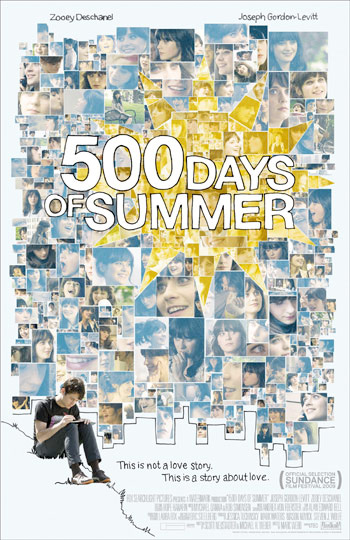
Review: 500 Days of Summer
To preface this review I believe it is of note that this is a movie that for various reasons I was highly interested in prior to its release. With this in mind, my first viewing of the movie was highly influenced by copious amounts of knowledge garnered both from interviews with the director and the cast, as well as numerous reviews from across the country. I must confess that with my head so packed with preconceived notions and perceptions, I feel another viewing is in order to fully appreciate the movie as a cohesive whole. With all of this in mind I will use the first half of this review to compare and contrast this movie with one of its predecessors and influences; Annie Hall. Due diligence and a genuine curiosity lead me to investigate the film before seeing 500 Days of Summer. Annie Hall is widely considered Woody Allen's best picture; a claim that until recently I was unable to verify. It seems sometimes popular opinion is correct as Annie Hall is at once a surprisingly timeless examination of human relationships, as well as a clever spin on a not-so-romantic comedy. This genre is not one that pops up too often in popular cinema for either the reasons that audiences are assumed incapable of tolerating anything short of a perfect ending, or an unenviable balance of humor and reality that may very well be tough to capture.
500 Days of Summer and Annie Hall share many things in common. For one, the films both begin with the admission that the focal relationships in question are unequivocally over and the male component is already on the other side. Each movie uses a fractured timeline in its conveyance of the emotion of a relationship, which is to say neither follows a primarily linear path. 500 Days of Summer uses the technique in a much more mannered way, informing the audience of the exact day (of 500) in which we find main character, Tom (Joseph Gordon-Levitt). Woody Allen in Annie Hall uses quick, jarring cuts to and fro throughout the relationship chiefly to juxtapose a moment either in the past or the future that is especially ironic when viewed next to an opposite from another time. There are many scenes in 500 Days of Summer that call back almost exactly to moments of Annie Hall. Specifically, a scene in which split screen is used to show Tom's expectations of a night at a party to the reality of how it actually happens. Webb noted that this scene in particular was a more modern spin on a scene in Hall when a conversation between Diane Keaton and Woody Allen is subtitled to juxtapose what the characters are saying with what they are thinking. If anything can be said about these two films as far as my comparisons are going, it's that one precludes the other and each attempts to reach the same endpoint via different means.
So, heaping these kinds of connections between a fairly new independent film and what is considered by many to be a classic film could be construed as being premature. In truth, when examining the subject matter in both films (that of a relationship that seems like everything and becomes nothing just as quickly with little reasoning) I find that both work in tandem towards similar interests. This is not to say the films are complimentary, or in some cases, even comparable. Simply the two take similar journeys and end up with different theses on the same subject. So what are the differences?
For one, 500 Days of Summer is much more concerned with cinematic style than Woody Allen's Oscar winning film, but not to the detriment of its story. 500 Days is told through music and bold camera work. In many ways its soundtrack is analogous to the way the current generation copes with many of the various foibles of life and love (that is to say, through music). It helps that said soundtrack is for the most part pitch perfect. A collection of offbeat, lesser known indie tracks perfectly supplements the moods Gordon-Levitt traverses throughout the film. This movie also employs an interesting twist on genre convention, focusing primarily on the male perspective in the story as well as putting said gentleman in the saddle of the hopeless romantic. It's basic role reversal, but it feels extremely fresh in this instance as movies rarely explore this interesting but no less real dynamic. Less of a romantic comedy and more of a coming-of-age tale, 500 Days of Summer deals with the realization that things like fate and destiny rarely align the stars in the ways we would like, and how naivety on this part can be the distinction between being a child or accepting adulthood. It warns of the danger of turning people into ideals, but does not abandon the audience completely to cynicism. Reassuringly, the film portends that ideals can be met with effort, or a lack of fear of putting oneself 'out there'. It never compromises on the hurt and pain of love and how it feels to lose it, but it's willing to offer a glimmer of hope with a wink to the audience before the final credits.
The setting of 500 Days is also unique in a few ways. For one, the director and cinematographer went to great lengths to capture the beauty of lesser known parts of LA. By doing so, Tom and Summer inhabit an almost postcard-world filled with vibrant colors and unreal focus. This elevates the narrative to an almost super-reality which is quite nicely anchored by some truly real emotional beats played out between the main characters. More than once while viewing this film I was struck by how accurate and real the interactions on screen were to life. Sure, this movie was taking place in an idealized setting, but the humans in it carry a certain reality and honesty I am hard pressed to identify in many other recent films of this nature. This is perhaps the film's greatest strength, and it allows the movie to play out in a way that is at once evocative visually of the way being in a relationship sometimes feels, while at the same time genuinely hitting these moments on a very personal level. These elements going hand in hand so well is something of a miracle, and it adds in spades to the charm of this story.
In the end, 500 Days of Summer is more an examination of what it means to grow up when something as tumultuous as love is the catalyst than it is of romance. It is a film of sometimes brutal honesty and tender humor that aims to almost empathize with the audience in shared misery, while at the same time trying earnestly to offer the hope that the world isn't as bleak as it can seem through the lens of our perceptions. It falls victim to one to three pitfalls of 'indie' movie making, but for the most part 500 Days of Summer is a challenging film that is not afraid to be honest about the harshness of life and love but will good-heartedly chuckle at it too.

500 Days of Summer and Annie Hall share many things in common. For one, the films both begin with the admission that the focal relationships in question are unequivocally over and the male component is already on the other side. Each movie uses a fractured timeline in its conveyance of the emotion of a relationship, which is to say neither follows a primarily linear path. 500 Days of Summer uses the technique in a much more mannered way, informing the audience of the exact day (of 500) in which we find main character, Tom (Joseph Gordon-Levitt). Woody Allen in Annie Hall uses quick, jarring cuts to and fro throughout the relationship chiefly to juxtapose a moment either in the past or the future that is especially ironic when viewed next to an opposite from another time. There are many scenes in 500 Days of Summer that call back almost exactly to moments of Annie Hall. Specifically, a scene in which split screen is used to show Tom's expectations of a night at a party to the reality of how it actually happens. Webb noted that this scene in particular was a more modern spin on a scene in Hall when a conversation between Diane Keaton and Woody Allen is subtitled to juxtapose what the characters are saying with what they are thinking. If anything can be said about these two films as far as my comparisons are going, it's that one precludes the other and each attempts to reach the same endpoint via different means.
So, heaping these kinds of connections between a fairly new independent film and what is considered by many to be a classic film could be construed as being premature. In truth, when examining the subject matter in both films (that of a relationship that seems like everything and becomes nothing just as quickly with little reasoning) I find that both work in tandem towards similar interests. This is not to say the films are complimentary, or in some cases, even comparable. Simply the two take similar journeys and end up with different theses on the same subject. So what are the differences?
For one, 500 Days of Summer is much more concerned with cinematic style than Woody Allen's Oscar winning film, but not to the detriment of its story. 500 Days is told through music and bold camera work. In many ways its soundtrack is analogous to the way the current generation copes with many of the various foibles of life and love (that is to say, through music). It helps that said soundtrack is for the most part pitch perfect. A collection of offbeat, lesser known indie tracks perfectly supplements the moods Gordon-Levitt traverses throughout the film. This movie also employs an interesting twist on genre convention, focusing primarily on the male perspective in the story as well as putting said gentleman in the saddle of the hopeless romantic. It's basic role reversal, but it feels extremely fresh in this instance as movies rarely explore this interesting but no less real dynamic. Less of a romantic comedy and more of a coming-of-age tale, 500 Days of Summer deals with the realization that things like fate and destiny rarely align the stars in the ways we would like, and how naivety on this part can be the distinction between being a child or accepting adulthood. It warns of the danger of turning people into ideals, but does not abandon the audience completely to cynicism. Reassuringly, the film portends that ideals can be met with effort, or a lack of fear of putting oneself 'out there'. It never compromises on the hurt and pain of love and how it feels to lose it, but it's willing to offer a glimmer of hope with a wink to the audience before the final credits.
The setting of 500 Days is also unique in a few ways. For one, the director and cinematographer went to great lengths to capture the beauty of lesser known parts of LA. By doing so, Tom and Summer inhabit an almost postcard-world filled with vibrant colors and unreal focus. This elevates the narrative to an almost super-reality which is quite nicely anchored by some truly real emotional beats played out between the main characters. More than once while viewing this film I was struck by how accurate and real the interactions on screen were to life. Sure, this movie was taking place in an idealized setting, but the humans in it carry a certain reality and honesty I am hard pressed to identify in many other recent films of this nature. This is perhaps the film's greatest strength, and it allows the movie to play out in a way that is at once evocative visually of the way being in a relationship sometimes feels, while at the same time genuinely hitting these moments on a very personal level. These elements going hand in hand so well is something of a miracle, and it adds in spades to the charm of this story.
In the end, 500 Days of Summer is more an examination of what it means to grow up when something as tumultuous as love is the catalyst than it is of romance. It is a film of sometimes brutal honesty and tender humor that aims to almost empathize with the audience in shared misery, while at the same time trying earnestly to offer the hope that the world isn't as bleak as it can seem through the lens of our perceptions. It falls victim to one to three pitfalls of 'indie' movie making, but for the most part 500 Days of Summer is a challenging film that is not afraid to be honest about the harshness of life and love but will good-heartedly chuckle at it too.
Subscribe to:
Posts (Atom)