Showing posts with label summer movie. Show all posts

Sunday, June 20, 2010

Growing Up Toy Story: A Review

Let's get some perspective here shall we? Toy Story came out in 1995. At the time I was only nine years old. From a young age I was bred to be a quite the fan of all things Disney. Toy Story was a brought to me by Disney. The film also happened to be about a young lad most likely not much younger than myself and his relationship with his collection of play things. The idea that toys have a life of their own wasn't a foreign one to me, even at age nine. My younger brother and I often fantasized about the lives our toys had when we were not present. And toys did we have. We were the kind of kids who amassed such a variety of toys that they filled to the brim a giant wooden toybox. We must also take into consideration that I may or may not be the most sentimental human being alive. So much is my nostalgia to even the most insignificant piece of memorabilia that the majority of my childhood toys still reside somewhere packed away among the boxes and boxes of junk my family has squirreled away over the years. I'm a sentimental packrat.

So what did this all mean to me upon seeing that first delightful film about toys and their lives? Not a thing. If I am honest with myself, I just loved the movie because it was great. There was adventure and a relatable through line. Indeed, Toy Story went on to be one of the most watched VHS tapes my brother and I owned. 'Most watched' isn't an exaggerated term here either. For weeks on end, it was our habit to watch the same movie EVERY night before we went to bed. For those of you who have known me a long time and know my tendency to be late to everything; this was one of the early reasons for my oversleeping. I had the Toy Story toys from Burger King, I had the store bought versions -- I even bought the special cloth version of Woody hoping he'd be something like his movie counterpart. It never was. We played the video game on Genesis to completion and we recreated scenes from the film as best we could using our heroic proxies. The sheer impact of Toy Story on my life is understated but concrete. From that day forth the company Pixar was forever synonymous with Toy Story.

Such was my loyalty to this monumental film that I have not to this day ever seen A Bug's Life. Hearing that the company that produced such a beloved film had betrayed my trust as well as that of Buzz and Woody, I subconsciously decided I would never partake in the blasphemy of it all. And then they won me back with Toy Story 2 in 1999. I was thirteen now and, like Andy, I was starting to outgrow the need to open the toybox or melt Green Army men behind the garage at our apartment complex. Still though, times would call and I'd find myself prone to childlike whimsy. Toy Story 2 was wonderful. It made me feel guilty all over again for the gradual unuse my toys started to see, and for a long while I was terrified that the plight of the toys in the movie echoed that of my own toys. Toy Story 2 was a natural thing in my life as by this time Toy Story had already become ingrained in my subconscious. Seeing it was about as common sense as breathing. The wonderful part about this sequel was that it ended on a note of finality. Woody and Buzz have come to terms with the fact that, indeed, one day Andy will outgrow his use for them as all boys do, but all along the way they will be there for him. It was touching and it was hopeful. I think that on some level I was unaware, this is the very reason I was finally able to accept Pixar's next film Monster's Inc.. The story of Woody, Buzz and the gang was over insofar as it could be, and I could move on. I'll admit I never saw Monster's Inc. or Finding Nemo in theaters as I was still mildly uninterested in any Pixar movie that wasn't a Toy Story film, but with time I have gone back and they are both wonderful favorites of mine.

And then, like Andy undoubtedly did, I grew up. Growing up is never something you do on purpose; especially if you're a boy. You wake up every day and one morning eleven years later you look back and all of those things that were so important to you have been replaced with new things. New interests and new entertainments. High school gave way to college. I got a job. My family moved. The toy box was stored away in a garage. I made friends. I learned to drive. I got in trouble. I made mistakes. I got a job. I moved away from home. I lost friends I wish I hadn't. I started paying bills. I took on responsibilities. And suddenly that little boy who I was sure I still was was gone. This realization gave way to the melancholy that a time in my life had come and gone without me even knowing, and it was time to move on to whatever was next. This last Friday I saw Toy Story 3.

Toy Story 3 finds Andy all grown up and headed for college. Woody, Buzz, and the remnants of a once glorious collection of toys sit solemnly day in and day out inside a toy chest. By all accounts they haven't been given a second glance in years. Confronted with the decision to either throw away his old toys or store them away in an attic, Andy chooses to take Woody along and store away Buzz and the rest. A mix-up causes the attic-bound toys to almost find themselves garbage-bound, when through a daring set of actions instead wind up being donated to a nearby daycare. The story is the least engrossing part of Toy Story 3. This is not to say that it lacks imagination or thrill. The sheer amount of creativity that Pixar puts into every tiny nuance of this film is mind boggling. The places and adventures the toys have in this film trump in scale and in spectacle almost everything the previous two films offered. The humor is strongly in tact throughout, and watching this movie feels just like going home. This is to say nothing in this movie feels like it's forcefully recreating the magic of the first films. Though every viewer will likely have an idea of where the chips will fall by film's end, the story is no less suspenseful or enjoyable for it.

Instead, the treasure of Toy Story 3 lies in its heart. While I know that any mildly well-adjusted child will enjoy the hijinks at play in this film, I can't help shaking the feeling that Toy Story 3 was made for boys like me. The boys who first took that adventure with Woody when they were nine and had become young men in the time since. Obviously, the experiences and growing up Andy has done are not detailed and I believe that's because all of us are Andy now. There is a very specific age group of my peers that grew up with these three movies, and this third in particular speaks to us as we look back on our long lost childhoods one last time. Toy Story 3 is a story about many things. It's a story about how important our childhood is to us. It's about growing up and what that means. It's about loyalty and how you treat those around you. It's about the crushing sadness of having to let go as well as the realization that it's okay to do so because those memories are never gone from us. Toy Story 3 tells the people like me in the audience that we haven't lost that little boy we were. It tells us that somewhere deep inside the experience of childhood guided us to where we are now, and that true friends never really leave us. Through the eyes of the toys we learn about what it means to be loyal and to never give up on those who are closest to us. We learn that friendship will get us through virtually anything, and we learn how to say goodbye.

Toy Story 3 is just a movie, but somehow to me it's meant so much more. The three Toy Story films stand as a mirror of my growing up. Toy Story 3 marks the end of my childhood in a way. It's an acknowledgment of my progress in life and a reminder of all of the new things I have ahead of me without ever compromising the importance of my past. It's hard to explain to some people what a movie like this is for me, and I imagine there is only a limited subset of people who will ever fully grasp this film in a manner similar to my own. I may not have realized it along the way, but the Toy Story franchise has taught me lessons all throughout my life. It was with a certain kind of joyful sadness that I found myself in the theater choked up to the point of tears during the final fifteen minutes of this film as I realized that Toy Story was teaching me my final lesson. I'm all grown up now and Buzz and Woody and all the rest don't mean to me what they once did, but they like the franchise itself will always be a part of me in a way. If this sounds like high praise for a movie; realize that it very much is the highest praise I can give. Toy Story 3 ended up besting even my loftiest expectations and because of that and the unique place it holds in my life it stands as not only the best Pixar film ever released, but one of the best films I have seen in a very long time. Bring a box of tissues, an attitude for a good laugh, and the little kid who's right where you left him... Toy Story 3 is worth every moment.

Tuesday, September 22, 2009

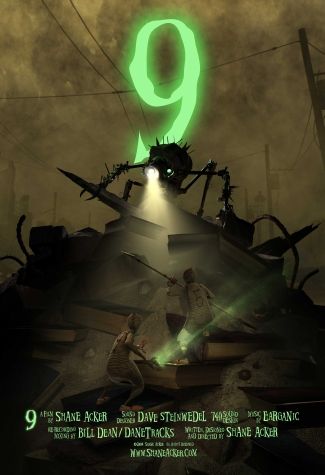
Review: 9

9 is the kind of film that you watch the trailer and feel a sense of anticipation over whether the movie itself can live up. Smarter viewers may have had the foresight to realize that the chances of this movie being as cool as the trailer were very slim. The main problem with 9 is that it ends up being what essentially amounts to a more drawn out version of the trailer. Things happen fast in this movie... really fast. From the opening moments where main character 9 awakens to a very post apocalyptic world, the plot moves at a bullet's pace. One moment he's becoming self-aware and the next he's meeting another sack-goggle-man. Then a mysterious cat robot is attacking and stealing a mysterious rune found by 9 in the first few moments of the film. All of this transpires in the first ten to fifteen minutes, and while it is very cool to watch, the movie starts to feel like all flash and no substance. This is not to say that 9 doesn't attempt to inject moments of exposition though. Instead the movie does try admirably to introduce the world and the little mechanical characters within. The only problem here is that when this movie slows down, it doesn't do a good job of informing us while not simultaneously boring us half to death.

9 relies far too heavily on the draw of its art style and quirky look of its characters. Passed the fact that they are cool looking sack robots that run around fighting with exacto knives and have staffs that have gears attached for style, there's not much presented in this movie to make it all seem intriguing. For instance there's a sack-pope leading a highly insular group by staying secret... but outside of the fact that he's wearing a cool pope-hat and a cape, the character is sadly one dimensional. He's afraid of the outside world and he's awfully close-minded. That's it. Even main character 9 is little more than the eager minded new guy who asks dangerous and controversial questions. The most interesting character in the film that did not feel shoe horned into some cliche archetype was voiced by John C. Reilly. Number 5 plays slightly naive, but overall is the only character going through a believable set of emotions and reactions that don't play specifically to his strictly defined character description.

Characters come and go in this movie so quickly and events transpire likewise. It's hard to stop and care about what you're seeing passed the occasional "oh man, that was cool looking". In the end the movie basically follows a predictable throughline which will have you more or less guessing the sequence of events. 'Blunt' is the best word I can think to describe 9. If it isn't set out right in front of you in plain terms, then there is no use thinking about it further than that. To its credit, the movie does try to end on a slightly ambiguous, interpretable note that leaves the viewer the task of deciding what is going to happen next. The biggest problem here is that in a movie where everything has been spoon fed with a pat on the head, the audience doesn't really care to engage themselves enough to meet this haphazard attempt at mystery halfway.

9 is based on director Shane Acker's short film of the same name. I think this is probably the main reason the feature length version falls so short. As a brief and silent vignette, the style of the movie and the pacing of the events works insanely well. It's evocative, it makes you think, and you don't have to sit through cliched dialogue coming from predictably defined characters. Obviously stretching the movie to fit a feature length, the short story had to be padded and expanded in multiple areas. Unfortunately for as cool and edgy as the film ends up being, the heart and soul of the source material was never meant to be spread so thin.

In the end, 9 is one of those films you try so hard to love but it never pays you back. If you still feel an irrepressible need to go out and check this movie out, I'd suggest waiting until it's either free on cable or available to rent. At best a diversion, at worst boring; 9 is another product of ambitious scope and a lack of execution.

Friday, August 14, 2009

Pellet Reviews: G.I. Joe, True Blood, and District 9

Whoa, so I'm a little behind on all of the media I've been intaking lately, but such is life my friends. Anyways, in an attempt to catch up in a manner that won't take up three posts and take me hours to write, welcome to my first edition of pellet reviews! That is to say, I'm aiming to keep these shorter than usual.

First up: G.I. Joe: Rise of Cobra

Hoo boy this movie had a lot stacked up against it going in. I mean, did anyone see the trailers? One has to question whether the PR team behind this film was asleep at the wheel or purposefully trying to sell the movie as brainless. Granted, what you see in the trailer is fairly close to what you get in the film, but fortunately for the movie itself the package fairs better as a whole.

To begin, G.I. Joe like Transformers before it is a chance to cash in not only on a profitable toy line, but also the dreams and fantasies of man-children everywhere. The plot is as simple as Duke (Channing Tatum) and his best pal Ripcord (Marlon Wayans) are tasked with escorting a new nanotechnology weapon to a secure location when they are ambushed by the hotter-than-usual (not counting the Alfie remake) Sienna Miller as Baroness. Wacky hijinks ensue and the elite but mysterious G.I. Joe unit swoops in to save Duke and his pal. Managing to save the nano weapon, the Joe's are impressed enough by Duke's action (Ripcord doesn't do anything but lay on the sidelines, but they recruit him too) to enlist him in their elite program. Cue the montage and before you know it, Duke and Ripcord are the best G.I. Joe operatives around, magically excelling in every training routine. It's not long before we learn the attempt on the nano-bomb was in fact a cunning ploy by the weapons designer, McCullen (Christopher Eccleston), to get his weaponry into the terrorist market. You see, he lives by the evil weapon maker code of playing both sides of a conflict. I believe the filmmakers were attempting here to comment on the state of the arms trade, but thankfully the surrounding plot and characters are so cartoonish and inane that the message never seems to penetrate the subconscious.

Anyway, before long the would-be Destro pinpoints Joe HQ using a tracking device in the nano weapon and his minions break in a decimate the unsuspecting Joe army. Before long the Joe's are on a revenge mission to retrieve the weapon before it can be used on the public, and the audience is treated to a number of fantastic set pieces which see the Eiffel Tower get destroyed, super suited soldiers running down the street dodging missiles at 80mph, and an assault on a subarctic underwater base. Somewhere in there the filmmakers attempted to shoehorn in a love story between misunderstood Baroness and Duke, and the shared loss they feel over the loss of her brother Rex (Joseph Gordon-Levitt). It's pretty tame and predictable, but it's nice that Sienna Miller gets to survive the proceedings if only for the chance she may sauce up the sequel.

G.I. Joe is a pretty mindless film, but it so embraces this idea that it actually ends up working much better than anyone may think walking into theatres. Honestly, it never tries to take itself too seriously, presenting itself at face value while not shying away from its share of eye-rolling jokes. This scenario works best in the favor or Marlon Wayans, who in most appearances only manages to annoy and distract from the rest of whatever movie he graces. Also on his side is the fact that supposed main character Duke is played by the acting equivalent of silly putty. Channing Tatum does well enough to deliver his lines without sounding like an idiot, but does little else to emote or evoke a connection with his character. This is a shame considering Duke is destined to become the charismatic leader of the G.I. Joe forces. Unfortunately, the best that can be said for this movie is that exceeds expectations, but that only amounts to a passable film. There are most certainly some cool action sequences presented here, but I felt they always just missed the peak of their potential. Luckily, the film keeps a brisk pace moving from one element to the next fast enough to keep the viewers distracted that there is hardly any substance to speak of.

Some credit must be given to Joseph Gordon-Levitt who apparently realized that this film allowed for a spectacularly over-the-top delivery so much so that when he delivers some of the hammiest lines in the film, you can't help but grin at the cheese factor. I imagine this was intentional, and it was also fun to see a villainous turn for the actor so soon after 500 Days of Summer. Credit must also go to Sienna Miller who pretty much embraces the fact she's there for eye candy. It doesn't stop her from being sufficiently both a combo of nasty and campy. It plays right until her inevitable redemption scenes which come off as forced and unnecessary. Almost-points finally go out to Dennis Quaid who hams it up in the bad way, and seems satisfied with punching in for a paycheck. See G.I. Joe: Rise of Cobra as a second-string movie theatre day or if you really think you can't handle engaging your brain on a lazy Saturday afternoon.

True Blood: 'Timebomb'

I've been very bad about my True Blood reviews as of late, and I definitely missed the boat on the episode before this one. This is not to say that the show has taken any kind of dip in quality. Quite differently, True Blood has cranked itself to eleven and all of the carefully established dominoes of the season thus far are tipping.

This week sees the tensions between the Fellowship of the Sun church and the vampire law of Texas come to a boil. Sookie's trapped in a basement with a turncoat human who's betrayed her to the Fellowship, Bill's trapped in his hotel room with his maker Lorena who has absolute power over him, and Jason's still an idiot. Meanwhile, back in Bon Temps Sam Merlotte is on the run and paranoid on account of demon-god Maryann running amok carving hearts out of people while causing everyone to have sweaty, black-eyed orgies. Tara and Eggs of course remain oblivious, and it's getting harder to ignore how ignorant they are becoming over the increasingly weird happenings around them. Also, vampire Jessica and Hoyt finally get it on for each of their first times and its very sweet until Bill barges in and surprisingly does not dismember the human.

This week pretty much had my jaw on the floor the entire episode. There were so many revelations and just plain cool moments that one would be hard-pressed to deny this may very well be the highlight of the season thus far. Godric the two millenia old vampire makes his appearance and Eric quickly finds him and Sookie. We are treated to a hilarious moment where Eric affects a bumpkin persona to try and non-violently escape from the Fellowship church, and before long all hell breaks loose. Surrounded by the Soldiers of the Sun, Eric and Sookie seem to be cornered... UNTIL all of the Texas vampire law-people bust in the front door and through some awesome vampire speed and power turn the tide of the fight in about four seconds. Bill knocks Lorena out with a 52-inch plasma screen TV and super-speeds his way to his woman, just in time for the fireworks. Steve Newlin, crazy in his desperation, holds Sookie at gun point until Jason saves the day; finally coming through and doing something not stupid. Right before the blood begins to spill, Godric appears and brings an unexpected peace to the proceedings, despite Newlin's prodding. One gets the impression that Godric is a different kind of vampire in this show, choosing to learn from his two thousand years of unlife and evolving as opposed to becoming more separated and routine. Given the fact Godric is played by a younger, shorter actor it is very fun to watch the rest of the vampire cast go sheepish around him.

The day saved, there's obviously an after-party in which Godric seems bored with the state of his unlife and the vampire snobbery, Jason apologizes to Bill and everyone about what a moron he is, and Lorena is banished by Godric. You almost, almost feel bad for her when Bill tells her he never wants to see her again. She's just a love sick murderer after all. The episode cuts out as one of Jason's pals from the Fellowship crashes the party, announces himself, and reveals a chest strapped with live explosives and what look like mini-projectile stakes. He presses the button and credits roll. Elsewhere Sam is still on the run, discovers Daphne's heartless body in a frame-up, goes to jail, and finds himself being able to trust only Andy. Tara and Eggs end up eating Daphne's heart thanks to Maryann's deceitful but delicious cooking skills, and proceed to beat each other senseless most presumably at Maryann's demonic behest. Lastly we are treated to a heart-breaking scene in which Jessica realizes she is an eternal virgin (at least physically) thanks to the timing of her vampirism, and you truly feel for her with Hoyt.

This is the kind of episode where you wonder how it all fits in an hour so satisfyingly. Revelation after revelation pays off, and no stone is left unturned (except for stupid Maryann, but it looks like we'll get some resolution next week). The story never seems to betray itself for the sake of melodrama, and instead lets the well established characters play for themselves. This is television at its escapist finest, and it's pitch-perfect. Wonderfully now that all of the disparate plot lines are all molded into a cohesive whole, it will be interesting to see what happens once the main cast and vampires return to Bon Temps and view the weirdness Maryann has laid bare. There's no real hanging what-if's, but the storyline is left wide open for some really great developments; not the least of which is the cliffhanger bombing this week.

True Blood is firing on all cylinders right now, and presuming it keeps it up with next week's installment, season two is shaping up to be a grander, greater version of the first already fantastic season. Do yourself a favor if you're not already and check out this show any way you can.

District 9

Where did this movie come from? In one night I very quickly found the third best film of the summer for myself. This is sci-fi at its very finest, telling a compelling and intriguing tale with some minor yet not blatant parallels to modern society.

The plot follows Wikus Van De Merwe (newcomer Sharlto Copely), a worker for the MNU organization tasked with evicting District 9. What's District 9? Oh, just a huge colony just outside Johannesburg, South Africa that happens to be inhabited by millions of an alien species that mysteriously showed up twenty years earlier. If it sounds intriguing, then this movie is already for you. The premise revolves around the concept that a massive mother ship appears in the skies above the city sometime in the mid 80's, and after months of inactivity, humans take it upon themselves to fly up to it and see what's inside. Instead of a creepy, malicious alien race akin to Ridley Scott's Aliens, or the kind from Independence Day we are treated to a malnourished and terrified race of bug-like aliens hopelessly lost without leaders. Doing the 'humane' (haha) thing, the world shuttles the aliens to earth and into shanty towns which become known as District 9. Flash forward twenty years and we jump into the film proper. Tensions between humans living in the Johannesburg area and the alien squatters are high, and the humans want the aliens to move.. Because it would seem the race is aimless and almost clueless even unto its own inner workings, it would seem that the only solution is to evict them from their shanty town and move them a number of miles away to a new one.

Unfortunately for Wikus who has just been promoted to head of the task force assigned to serve eviction notices to the alien squatters, District 9 has become more like a slum -- rampant with crime, arms dealing, illegal inter-species prostitution, and a well-entrenched human contingent content on exploiting everything around them for power and weapons. The opening third of the film is told in a documentary style that for me hearkened back to Cloverfield in its sense of conveying the illusion that what we're seeing is real, but with not nearly as shaky of camera work. The universe they've set up is exceedingly believable, and as we watch the early scenes as Wikus uses his know-how and expertise to evict the aliens while navigating the complexities of their culture and lifestyle, one is drawn willingly into the desolate world of shaky civil rights and complex moral lines. Apparently, the script is reminiscent of director Neill Blomkamp's time growing up in South Africa during apartheid, and its easy to see the invocations between that and the fictional eviction of District 9.

Everything is going fine for Wikus until he evicts an alien the audience knows to be up to something nefarious at best. Stumbling upon a mysterious canister which we later find out to be a fuel cell, Wikus is sprayed in the face by a mysterious black goo. From here his life more or less cascades out of his control, and the audience gets to watch a very Kafka-like transformation evocative of the Metamorphasis. Wikus slowly begins to literally come apart at the seems, treating us to disturbing visuals of finger nails being torn off, teeth falling out, and grotesque alien exo-skeleton growing beneath his skin. Not the least of his problems, Wikus' newfound transformation allows him to operate the genetically encoded, and until recently, useless alien weaponry that the MNU has amassed but been unsuccessful in actually firing. This makes Wikus a valuable military commodity and after a close call with the chopping block, he retreats and must take refuge in District 9. What follows is an interesting character study of how a man can change both literally and figuratively in such extreme conditions. Watching Copely's progression from slightly nerdy office-man to jittery, end-of-his-rope refugee is at once heart-breaking and believable. Given to extreme circumstances, Wikus must try and survive in the harsh conditions of the slum and he eventually stumbles upon the very alien whom created the fuel cell that is transforming him. Turns out that this particular alien and his son are a breed apart from the aimless, shiftless creatures populating District 9 and have taken the initiative to repair their command ship and intend on reviving the mothership. With a promise to repair Wikus if he were to help retrieve the cell, the movie transitions into one man's quest and the lengths he will go to escape his plight.

District 9 has some pretty impressive effects for a movie made for a relatively small $30 million. The aliens in the movie feel real enough to not be distracting, and emote enough believability so as to connect with the viewer in a way that involves one passed the fact they are a fancy CG effect. Once Wikus gets his hands on some of the cool alien weaponry, we are treated to some light action scenes in which some extreme violence ensues. It becomes pretty commonplace to see people literally burst like bloody water balloons in this film, and that is only the most common way random soldiers bite the dust. The important part of all of this is that even though you can kind of predict the character arc for Wikus, you never quite know the circumstances of how it will happen or where everything will end up. The movie also raises a lot of questions about basic civil liberties and it definitely left an unsure feeling in me as to which side had the moral high ground. Tensions run high in this film the entire time so that you are riveted to the screen for the duration of the running time.

By the end, you've seen Wikus' journey from naive, office nerd to hardened and bewildered refugee. The closing moments of the movie remain ambiguous, offering no solution to many of the grand problems of the situation or revelations as to the future of many of the main characters. Instead, District 9 leaves audiences with a sense of uncertainty which I am sure is intentional by the filmmaker to echo various scenarios in many parts of the world. Does war lie on the horizon for Earth? Is violence the only outcome of such a parasitic culture? Is there a peaceful solution in the end? It's the mark of good science fiction when you can walk out of the theatre without the pleasure of a tidy ending and still be satisfied with the film you've seen. District 9 may just be the sleeper hit of the summer, as it surprised me in a way none of the summer movies of this year have. Just behind Star Trek and 500 Days of Summer, District 9 deserves to be seen if only a passing interest is involved. Don't miss a chance to see a movie that is refreshing in it's new take on a familiar genre and it's ability to make you care.

Thursday, July 16, 2009

Review: Away We Go

I had no biases or ideas coming into Away We Go. I didn't see any trailers and I didn't read any reviews or articles. The only thing I did know going in, which I forgot until the credits rolled, was that it was directed by Sam Mendes. Some of you may know that he directed Revolutionary Road with Leonardo DiCaprio and Kate Winslet, Jarhead with Jake Gyllenhaal, Tom Hanks' Road to Perdition, and American Beauty. All of these are good films to varying degrees with the exception perhaps of Road to Perdition which was kind of hit or miss as far as I was concerned. His high point was Revolutionary Road, which was at once one of the most real and depressing movies I have ever had the (dis?)pleasure to see. Anyways, as I mentioned before, I forgot that he directed Away We Go so why I went to such great lengths to recount his past films is beyond me.

I'd start by saying Away We Go is largely a harmless film. What I mean by this is that it never presents a specific conflict to be overcome or put our chief characters in a position that one wonders how they will survive. This isn't a bad thing, but I imagine that the movie leaves itself open to multiple interpretations. The story revolves around Burt (John Krasinski) and Verona (Maya Rudolph) discovering in an uncomfortable opening scene that they are going to have a baby. Shortly after informing Burt's parents (Verona's are dead, a plot point addressed half heartedly throughout the film), they discover that said parents are moving out of the country a month before the birth of their grandchild. This is shocking to the pair as they have apparently settled into a life devoid of connections outside of Burt's wacky parents; played to hilariously unnerving effect by Jeff Daniels and Catherine O'Hara. The obvious move? Fly across the country to 'test drive' different locations and friends/family until they find a place that they feel comfortable. Life lessons, unpleasantries, and acceptance follow closely in their wake as they both learn to put focus on their lives one experience at a time.

Right off the bat, the premise of the movie seemed slightly shaky to me. Deciding on a new place to live with more friends or acquaintances makes sense, but flying across the country and awkwardly meeting with estranged friends and family? It's hard to swallow, especially taking to light the fact that the apparent sub-middle class surroundings they call home don't exactly scream extra money to afford such an extravagant experiment. Needless to say, the movie is spared this slightly incongruous element by the amount of heart the filmmakers are able to inject into the story. This is thanks in no small part to both Krasinski and Rudolph. The former puts in what amounts to my favorite performance by the Office actor; infusing his character with some genuine emotions and for once non-generic delivery. Maya Rudolph was an x-factor for me and she defied my perceptions of her and created a likable and real character in spite of it. It helps that the two actors have a believable chemistry so much so that the film does not have to labor to convince you that they are good together. It's also worth noting here that this movie also contains the one performance I've ever enjoyed from Maggie Gyllenhaal. She's surprisingly funny and her timing is spot on here; she makes her character.

So they set off on their journey, and each encounter is significantly weirder than the next. These scenes almost push the envelope of believability, but the central couple plays well as the proverbial 'straight man' so that the insanity on screen is appropriately shared with the audience. The movie doesn't do much to provide a point to its proceedings besides one vignette to the next. Despite all this I believe that a discernible meaning to it all can be plundered from all of the experiences our characters happen upon. The movie seems to deal with the inevitability of life and the things that happen to everyone. Burt and Verona visit different sets of people whom have all experienced life and dealt with it in different ways with the exception of Verona's sister who helps them realize they've been lucky together. They experience the unhappy couple who are not dealing with parent and adulthood very well. They meet the couple that seems to have a perfect situation, but secretly struggle with dark personal demons that at once cement their bonds and test their emotional strength. They also view the remnants of a couple destroyed by the pressures of what Burt and Verona are venturing into. It's at this juncture that they learn the most important lesson: there's no telling what the future will bring suffice it to face it together and to use the lessons of the past.

Away We Go ends up being much lighter fare than some of Mendes' previous efforts and ends up falling victim to some 'indie movie' tropes, but has enough heart to still be worth seeing. I imagine that people closer to the age of the principal characters will find many more lessons about adulthood than someone in my shoes, but the movie is still worth it in a much more general sense of growing up. There's a sense of inevitability to the proceedings in this film and to real life by proxy. The audience is left with the same feeling as the characters in the final scene: We can only do what we can do and hope that it gets us through until life throws the next curve at us. Overall though, Away We Go is a heartfelt movie that will leave you with a sense of hope even though it doesn't outright promise that life will always yield it.