Monday, January 9, 2012

on Over Analyzing.

In order to properly function in the course of our day-to-day lives, it is imperative that we analyze the various stimuli encountered therein. This is a fairly obvious concept. When we make a note that a friend is sad or keeping a secret, we know these things from the various social cues that we pick up from observing the world around us. The human ability to translate passing subtleties into informative notions about our external surroundings is truly a remarkable trait. We spend so much of our time processing every parcel of new sensory information that often times we fall victim to the pitfalls of over analyzation. This intricate abnormality in the way in which human beings interact to the world around them is in and of itself both fascinating and troubling.

Over analyzation can manifest in any number of suitably distinct ways. Most often, we over analyze when fixated on an idea or thought. The way in which one goes through a day while simultaneously and subconsciously processing every stimulus presented is almost without notice. Our brains allow us to operate routinely, often without our own realization. This allows us to function in a social setting in a manner that is appropriate to both our own means and the expectations of others without wasting half of our time in figuring it all out. Fixation occurs when an idea, conclusion, or thought does not 'fit' within the constraints of our regular, subconscious processing. Once this has occurred, we begin to actively assess the idea over and over until our conscious minds can produce a satisfying explanation that sates the part of us that finds fault with it.

The trick, if there is such a thing, is that oftentimes the things we perceive as commonplace do not hold up to rigorous scrutiny or 'logical' deduction. Take the idea of a friend that is sad. How do we know he is sad? Perhaps his face looks sad. What looks sad about his face? His eyebrows are arched and his mouth is frowning. Why are those looks associated with being sad? Most sad people have this face. What if that is just how his face normally looks? This is just a small example of the complex logic chain involved with deducing very common things. Obviously, we do not go through such a strenuous investigation every time we encounter something. Our brains use 'shortcuts' -- workarounds that allow us to get from the proverbial Point A all the way to Point Z without ever having to consider Points B through Y. Over analyzation occurs when we need to reach Point C, and along the way from A we somehow invent not only Point B, but D, E, and F as well.

The problem lies in the subjective brain. Deducing contextual clues to reveal an understood truth requires logical links between greater social concepts, reality, and assumed plausibilities. The subjective brain, unfortunately for us, is only truly certain of the third [Author's Note: I've made a case for reality before -- Link!]. Reality and social concepts or norms are both equally important in processing, but for this discussion are irrelevant as they exist (albeit arguably) outside of the subjectivity of the individual. Assumed plausibilities are what we subjectively know to be true based on all of our previous experience in analyzing our surroundings. For instance, we know that if we insult someone, they will most likely get very mad at us. In maneuvering from the conceptual Point A to whatever conclusion it is that our minds reach, we rely on assumed plausibility for our navigation. It is important to remember that 'plausible' does not equal 'certain'. We can only guess at the reactions of a world outside of our own heads, and those guesses will vary as wildly as there are people on the planet. Over analyzation is the product of this: our brains making logical connections that may not or do not exist and the struggle with the conclusions that we reach based on them.

Of course the real dilemma is not the 'why' or 'how' of over analyzing the situations we experience; it's the 'what to do'. Some obsess about every word and action; every perceived slight or hidden meaning. These people find it hard to take anything at face value. Others simply take everything they perceive exactly as it is. These people are often labeled as 'gullible' or 'ignorant'. Each has its advantages. The former often sees the world shrewdly, and avoids the various complexities of assumption. The latter is often free of the constraints of being burdened with the knowledge that what one sees is not always what is true. Perhaps the real truth is that there is no easy solution when we find ourselves over analyzing something. To rely on basic presumptions can be almost foolish, while always presuming that things are not what they seem is equally so. Maybe we are all best served when acting according to instinct. Over analyzation is simply our instinctual reaction to that which we suspect is not simple. In the end it is best to believe in ourselves throughout, because it is true what many people say: When you believe in nothing, you will fall for anything.

Monday, October 24, 2011

Monday, October 17, 2011

Implications.

What are the limits of the things a single person is capable of doing? How do we know of the things that we can accomplish and the things we will only ever glimpse in the rear-view of life? Furthermore, what allows us to accurately assess ourselves without falling victim to the pitfalls of hubris? Human life is an exceedingly insular experience so much so that one can never do better than guess the intentions and thoughts of those around them. Because of this, one stumbles through their days in a gross approximation of what they believe the world around them will be able to tolerate -- how others will assess them. If one cannot properly gauge one's own place in the grand scheme of social consciousness and order, how can they ever make a forward-thinking decision without the larger social contexts that would properly inform them?

Obviously, we all make choices every day. We make them without really thinking about implications. In part, this is likely a mechanism we are trained since a young age to enact subconsciously in order to avoid the confusing and aggravating mental aerobics that result in wordy paragraphs of this nature. Admittedly many of the little choices we make in a given day are of almost nonexistent consequence to anything. What color shirt we choose to wear doesn't really effect the course of our lives in any discernible way. The kinds of decisions that matter are the kind in which it seems most intimidating to confront. Financial decisions and the truly intertwined nature of money in the social context of a human life realistically weigh monumentally. Choice of careers, choice of partners, choice of location and all the logistical and personal ramifications thereof; all of these are so large that they paralyze the logic centers of the brain. Perhaps it is how we react to this phenomenon that defines the paths we choose.

Reaction is key. All the forethought in the world, all the confidence, means nothing if in the end we are unable to act upon it. Some people react to the crushing weight of our own influence on the course of our relatively short lives with ease. They accomplish the goals they need to advance to a state of comfortability within the strictures of social human living. They do this simply because it is the thing to do and it suits the potential possibilities of their lives. Others over analyze (the irony of which does not go overlooked). They let the weight of the realizations freeze them in a perpetual state of unmoving. Some others dislike the idea of adhering to some great and imposing social norm.

The questions posed here are too hard to objectively answer. Everyone needs to choose for themselves -- react. Certain factors can motivate us to change, to envision a better future; the ability to overcome our natural inclinations. In the end, we choose almost without thinking. Our minds are already hard-wired to assess the world in the way we have grown accustomed. Perhaps the real secret to life is to live it. To react and live in the moment. Some would say there is always time to 'stop and smell the flowers', but maybe stopping is the exact opposite of what the nature of time dictates? The limits to our potential are, for the most part, creations of our own designs. Maybe we already have the answers to the questions of decisions and the ways in which they affect our lives. They are already there waiting for us to acknowledge what we already know.

Monday, July 18, 2011

The Accelerating Oblivion Race with no Finish Line.

As I get older the passage of time and the sequence of events that I experience become increasingly perceptively transient. Perhaps it is a symptom of growing older, and maybe it has something to do with the age group of which I am a part. Regardless of the reason, events accelerate more and more and I find myself astounded with how quickly time passes and how trivial the actions of myself and all the people around me seem. All around people live, they get into relationships, they get promoted, they graduate, they move, they achieve and they strive to succeed. Lately all of these endeavors have left me cold in that my mind continually seems to focus on the bigger end goal -- in other words, to what ends do we toil away in our little lives? Do we work towards some benevolent 'greater good'? Are we really furthering humankind by getting a degree and working a 40 hour a week job for the rest of our lives? Is artistic expression of any more value? For every 'Mona Lisa' or 'Sistine Chapel', a thousand thousand artistic expressions will have absolutely zero effect on the rest of the world. Movies are made and given increasing importance, but what does it add? A distraction; a subterfuge to divert attention to the fact that we are all hurtling light speed towards an ambiguous ending?

What's the point?

Perhaps the point is selfish. Maybe life and all of our secret machinations should be geared exclusively towards our own subjective pleasures. Maybe we should travel the world to see everything we can. Maybe we get the degrees so that we have the money to buy all the nice things that we believe we should have to obtain a complete life. Selfishly we can pretty much have it all, or better yet anything that we define 'it all' to be. Maybe. As for me, I find that a subjective existence is perhaps personally rewarding, but ultimately meaningless. As masters of our own destinies, we are in control to the reaches of our own little confined worlds. I can see how that would be enough for some, but personally (and perhaps ironically -- subjectively) it seems hollow. Anyone can be astonishing if they're setting the bar for being it.

If I was being honest, I think I am probably complicating matters far beyond what they should be. Fulfillment is subjective. One man's success is another man's wallowing. In the end, does any of it have meaning beyond the fact that we have satisfied ourselves? Is that enough? I enjoy my life. I do things. I do as many things as I can, but instead of feeling accomplished I wonder if I fill my life with events to ignore the fact that I'm doing it because I can't handle what's left without them.

Life is a series of events chained together to create a personal and unique timeline that ends up defining our existence. What if that series of events are just an unstoppable collection of moments we blindly choose as we miss the fact that time will run out before we ever get close to putting it in perspective? The more we do the faster time ticks away and sooner rather than later we turn around and realize we're just a series of memories that may or may not matter. And by the time we've realized this, isn't it too late to get context? Time is too big and we are too small to ever understand it the way its meant to be. I probably have a lot of life left to live. Still, I can't shake the feeling that the rest of it will play out fairly predictably; universally speaking. I'm racing towards oblivion at the variable speed of time and no matter what I do I can't seem to find how that counts. Is that the point?

Sunday, May 29, 2011

Thursday, May 26, 2011

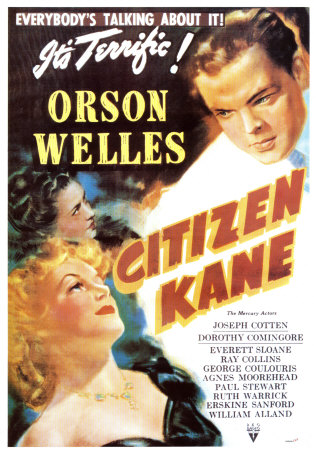
Semester Series: Context and Achievement in Citizen Kane.

Citizen Kane is a lot of things. On one hand, it is a film about one larger-than-life man and his seemingly fantastic life. On another, Citizen Kane is a sterling touchstone of both America at the time of its release and one of the first glimpses of the true and realized potential of cinema. This film attempts to take on the scope of an entire life and put it into the perspective of a single word -- a word which is without context and that propels the exploration deep into territory far more significant than its subject. I'll be the first to admit that I am usually the first to line up to denounce universally heralded works in media. Far too often I feel that Hollywood tradition being what it is, truth often gets lost in the ether. To my genuine surprise I found myself thoroughly entranced by Citizen Kane for a number of reasons; many of which may be emblematic of its legacy and staying power.

Chief among my surprise was the overall look of the film. Welles frames almost every shot in the entire film that it could be a still picture. Each frame is deliberate and filled almost to bursting with details. These very same details are what set this film apart from its contemporaries. The perception of modern generations is that old films were generally more 'theatric'. This is to say that acting was more of a grand melodrama than an acute approximation of real life. In keeping with this trend, movie sets of the time felt more manufactured. A set was indeed a set; meant to give context to location but not become anything more than dressing for a scene. Citizen Kane defies this tradition as every location in every scene has character. The world of this film feels very much real, very much believable. This tactile sense lends a gravity to the film that can't be denied and establishes Citizen Kane as a true departure from the theatrical roots of the art form.

Aiding in its picturesque quality is the lighting. Welles lit the film from an artistic eye. Dramatic and contrasting shadows paint every scene in gritty realism. Actors' faces are not always lit perfectly, and they move across the scene through beams of light cascading from windows or lamps. Still, even though the lighting may lend itself to reality, one cannot shake the sense that every ray is cast with purpose. Every silhouette adds to the frame that, combined with the elaborate settings and locations, demands to be taken in by the eye. Citizen Kane is a film that employs almost every tactical advantage of the form and achieves it with effortless perfection. No one element of this film ever arrests your suspension of disbelief or strains the logical understanding of information. Even while it reaches for both cinematic and technical heights, Citizen Kane never feels like its presuming to be anything more than it is. In essence, each element bolsters the next to simply exist; nothing more.

The above elements would be enough in many cases to justify the lasting impression of the film to modern audiences were it not for the story. In strokes both grand and mundane, this paradox of achievement is in no small part testament to the greatness of this film. By definition, capturing the scope of a human life in the span of a couple of hours is grand enough achievement on its own. To maintain the feeling that said human life is just as real and actual (mundane) as any other is perhaps more crucial. There is no denying that the film pivots and flourishes exclusively from Charles Foster Kane. All at once Kane is equal parts Bruce Wayne and James Bond -- possessing all the reckless excess of those characters while at the same time their tragic flaws and adding an intangible human element. Kane is the quintessential archetype for ordinary man of ordinary means thrust into extraordinary wealth or circumstance. This makes him engrossing and relatable all at once, and it is his gravitas as well as his presence that makes the film work. Indeed, in some ways Citizen Kane isn't even about its titular character. Instead it often chooses to focus on his very effect on those around him in an attempt to better understand his life. This movie is a lot like life in that it is about context. The context of one life in light of itself. The context of the lives of others in contrast to another. Citizen Kane endures because it's simple on a level anyone can understand.

Finally, and many of my classmates have commented on this in their posts, Citizen Kane teaches an important lesson. Charles Kane is a man who could have anything and yet always lacked for substance. There are many scenes illustrating this point in the film, perhaps none more resonant than Leland and Kane's late night discussion on the eve of his losing the race for governor. There, a drunken Leland actualizes the dilemma of Kane's entire life. Kane gives in an attempt to gain, but instead of a monetary gain he wishes for an emotional one. Simply put he wants to be loved and from this he achieves both his greatest successes and his most profound failures. In the end I believe it all winds down to his final words: Rosebud. Kane was a child plucked at an unbelievably young age from his childhood and forced to be scion to a wealth he didn't choose. Rosebud is his childhood sled, but more than that it is his stolen childhood. It is the stolen love of his mother and his family. Rosebud is the unspoken rejection by his mother which in turn is the denial of the most basic thing a person needs -- love. The rest of Kane's life is a pursuit of that lost moment. He fills it with people and gestures and possessions, none of which is able to fill the hole in his being -- a hole that was compensated for by an overbearing selfishness. Not a selfishness born of malice or want, but an unconscious one at a fundamental level.

What I am trying to say is that Citizen Kane in the context of its main character is a story about being human. It lasts because even though it is slightly larger-than-life, it maintains a sentiment everyone lives on a daily basis. This combined with its technical feats make Citizen Kane more than substantial enough to bear lasting study and adoration not just for now, but for times to come. If nothing else, this film is undeniably 'tight'. Tight in the sense that its parts are as good as its whole, and nothing in its narrative is a stretch of the mind. Perhaps this is why it has avoided critical scrutiny and, more importantly, the test of time.