Thursday, August 6, 2009

Review: The Hurt Locker

The Hurt Locker is the newest in what I consider the new generation of war movies. The trend of the last fifteen years has been to focus on World War II era drama films while largely ignoring the Korean or Vietnam Wars. Perhaps embracing one of the most hot-button issues in today's world, there has been a recent emergence of media dealing with the contemporary war in Iraq as well as Operation: Desert Storm. I imagine the latter has also seen a popularity boost because some creative minds may find it easier to comment on a situation that has already concluded than one that is not only ongoing, but also very sensitive in our culture. The Hurt Locker continues the trend of both Sam Mendes' Jarhead and HBO's adaptation of Generation Kill in what I like to refer to as the 'desert war film'. Unlike the more or less historical depictions of soldiers fighting in the Second World War, modern war movies are more inclined to get inside the heads of the soldiers fighting. This is an interesting and unique take, but all the more understandable given the fact that the veterans of these battles are in ready and abundant supply. Films about modern war run the tenuous line of being analytical and being preachy. Either way it's a unique time to not only be making these kinds of films, but to also be watching them.

The basic premise of The Hurt Locker is the examination of an elite bomb diffusal squad stationed in Iraq circa 2004. The opening scene of the film takes strides to establish just how paranoid and volatile this warzone was five years ago where bombs are planted in the middle of busy roads hidden under trash, and it seems like any Iraqi bystander could be a threat. The scene puts the viewer in the headspace it needs to be for the rest of the film; one which anything can happen at a moment's notice and death may only be one mistake or moment away. To a large degree this tone helps establish the mind set one has to be in just to be present in that kind of warzone, let alone to be the person who diffuses explosives at point blank range. We are introduced to the centerpiece of the movie, Staff Sergeant William James (Jeremy Renner), fairly early in the film, and how he interacts with his squad mates JT Sanborn (Anthony Mackie) and Owen Eldridge (Brian Geraghty) is the core of the film. Each soldier embodies a different archetype: James is the devil-may-care type who seems unaffected by his dangerous work, Sanborn is the straight laced, no-nonsense man of duty, and Eldridge is the somewhat naive, good-hearted yet frayed soldier in need of guidance. While this may seem fairly common in terms of characterization, the way in which these men interact throughout the course of the film not only informs the audience of their psyches, but each other's as well.

Right away, it's clear this movie is fairly somber in mood. There are no overly happy moments where our characters are carefree and overtly cheery, but the movie does well to avoid wallowing in melodrama. Instead the movie seems to provide an honest portrayal of what life in an increasingly hostile environment would be, and probably is, like. Moreso than any movie of its kind in recent memory, The Hurt Locker effortlessly puts the viewer in the mindset of it's characters. I found myself dwelling on the stakes of their plight as well as the kind of thoughts you have to have and suppress to prevent total panic more than once throughout the movie's slightly overlong two hours. As the movie progresses, we also see how Sergeant James deals with the same thoughts. Beginning as essentially a man who does not seem to care what happens to him as long as he's safe and does his job, actor Renner is able to portray a man helplessly attracted to the thrill of living in that moment between life and death. More than once we see how the pressure catches up to him and he is believably overcome with the extremity of the situations he finds himself in, only to bottle it up and return to duty seemingly unaffected. It's effective characterization for one can not help but wonder what effort of will or conscience it takes to see the things some of these soldiers see and walk away unshaken.

In the end the movie wraps up and we are treated briefly to James back home in the USA. Perhaps the most damningly effective and informative part of the movie, we see how he copes with the mundane facets of everyday life that are so far away from the explosions, gunshots, and death of Iraq. We also see how the adrenaline high of being a bomb technician has taken any of the color out of his day to day life. The viewer also finds themself wondering whether it really is the rush of the job or instead the horrors he's witnessed that have left him so singular in his interest. At the end of the movie it's hard to peg this film as any one thing. On a level it is a look into the minds of the men and women who find themselves in a constant flux of moments between life and death. On another it's about the way war or even living surrounded by constant death can numb a person emotionally and mentally. This movie succeeds on both of those fronts to be sure and the best thing to be said about it is that it makes one think. In a cinema climate where producing the most shocking visuals can sometimes be paramount to actually saying something with the art, The Hurt Locker presents its subject matter in an inobtrusive way that leaves the analyzation almost exclusively to the audience.


As an aside, I have to say that the above poster does not evoke an iota of the tone of the movie it represents. In fact, I would almost say this poster is the farthest thing from an accurate representation of the film, opting more for an edgy, almost action oriented take on what is more or less a character study. Hmph.

Monday, August 3, 2009

Picture: My Gigantic Yet Creepy Sentinel


There's a pretty funny story as to how I ended up getting this picture, suffice it to say that as you can see I got rained on again. I took this after 45 minutes of feeling like I was in a maze and this guy just looked smug. Also, is it just me or does rain make every picture cooler?

Saturday, August 1, 2009

Review: Funny People

Sometimes it's hard to remember that while Judd Apatow and the gang of actors he's come to be associated with have had a tremendous film presence in recent years, this is only the director's third time behind the wheel. Even with that knowledge, Funny People feels right at home inside this relatively new genre that essentially spawned from Apatow's earlier films. This is a double edged point for the movie. On one hand, the audience knows what to expect and the cast is primarily well known. On the other, the audience knows what to expect. A number of films starring these same actors have been released in the last few years. From the top of my head I can think of Superbad, Forgetting Sarah Marshall, I Love You, Man, Zack and Miri Make a Porno, Pineapple Express, 40 Year Old Virgin, and Knocked Up. I imagine I even missed a few there, but essentially these films have the same faces showing up and plots that, while different, share a vast amount in common. In each of the above films we expect a very lude, envelope pushing first act that isn't afraid to "go there", and a second act which almost always has a heartwarming message about either love or friendship. It's a fairly worn genre that has been upgraded to the kind of unabashedly real, no-compromise formula we see today. And it works. It speaks to the youth generation of the day, but the problem is that it's becoming worn once again. This is the chief problem I placed in front of Judd Apatow walking into Funny People, and while I wasn't blown away afterwards, this film definitely surprised me in a lot of ways.

The first place to begin in a movie from this group is obviously the cast. Dually lead by both Adam Sandler and Seth Rogen, both actors are well-known so that the impetus to entertain and hopefully bring something new falls on them. Sandler turns in a pretty convincing performance here in what essentially amounts to a dramatized version of his own life. The usually zany, but oddly emotionally detached actor is able to channel a very introspective performance for this film. I found that it's almost as if in having to get in touch with earlier aspects of his life and career, Sandler was forced to not only come to terms with but also repurpose parts of himself that seemingly fell away over the years. It all adds up to a very self referential turn for the well known actor, and stands as one of his more heartfelt performances in years. I still don't find him particularly funny, but the way Sandler addresses it is more tribute than pastiche. It comes from a genuine place and that resonates regardless. Seth Rogen is pretty huge these days, and the number of movies he's appeared in over the last two years is staggering. Fortunately for him, it seems he has the talent to back up his exposure. With a distinct look and one of the most unique laughs in cinema, one would think that it would be tough to distinguish the actor from any of his characters. Here Rogen plays against type (which is to say carefree, upbeat, stoner with a heart of gold) and manages to convince the audience that he is Ira -- a self conscious, insecure, and emotionally in-touch individual. It's not played for laughs either. Like the rest of the movie, you cheer for Ira as he slowly gains confidence in both life and career. Most importantly, it feels like a real progression. I'd be lying if I said that the scenes with Seth Rogen in them were more interesting to me than the ones with just Adam Sandler.

The rest of the cast does a serviceable job. Jonah Hill is the slightly manic, fast talking guy we've seen before. Leslie Mann does a good job of playing a woman torn in half by the turmoil happening all around her life, and you vicariously feel her dilemma. Jason Schwartzman jumps between being hilarious and over-the-top. One moment he's pitch perfect as just exaggerated enough to be real, and the next he pushes it slightly too far into the realm of outrageousness. Eric Bana does a great job as the overly butch, Australian husband to Mann, and it seems his comedic background serves him well. He knows he must essentially be the antagonistic jerk, but he plays some hammier elements of the character up just right to garner laughs. Most importantly he is able to earn a sliver of sympathy which is invaluable in the final act of the film. The movie is also chock full of various celebrity cameos, the least successful of which goes to Eminem who does a fair job of realistically delivering his lines, but when tasked with being funny falls a little flat.

Funny People is basically two movies in one. While I have heard the argument that the movie's heart succeeds best in the first half in which Adam Sandler's character believes he is terminally ill; I find it hard to agree. Without the second act which focuses primarily on Sandler's George Simmons attempting to get back the girl of his dreams, the movie runs the risk of swimming in all too familiar waters. Too many movies have dealt with dying, learning to accept it (or not), and the arc of that journey. It would be impossible and unwise of this movie to walk the same road. Instead, Funny People chooses to use the less travelled road of showing what happens when you stand on the brink and get a second chance. Though not altogether a new concept, it allows the film to do a lot more than it would have otherwise. Once these elements are established, it's easy to field where the movie is headed.

More than once during the film I worried that we were going to get another mushy, gooey Apatow ending serviced by convenient plot devices and copious amounts of emotion. It's on this point that the movie surprised me most, bucking a number of trends I fully expected it to embrace. First, even after having a life altering experience, George Simmons is not definitively the hero of the story. Things happen that cause the audience to really wonder if the right thing is happening, which in turn causes one to think deeper about the circumstances of the unfolding story. Second, unlike the previous two Apatow films, everything does not necessarily end up ideally for the protagonists. For once it feels like a bow hasn't been tied around everything and it leaves the viewer the opportunity to decipher for themselves one or two elements of the story. This is certainly a rare and unexpected treat in a movie from this group.

Lastly I will call into question the comedic element and thusly the titular 'Funny' in Funny People. This film falls more into a dramatic category than a comedy line of thinking, but never misses the opportunity to invoke a laugh. For this reason, I cannot recall during this film a time I may have laughed as hard or genuinely as I may have viewing previous efforts from this director, but I also cannot remember feeling there was any value to the film after the credits rolled. In the end, Funny People is an average movie to me. It doesn't astound or revolutionize, but it does just enough to distinguish itself from its peers in my mind that I feel it's worthy of being called the most thematically successful Judd Apatow movie, if not the funniest. See this movie if you want an amusing diversion which possesses the requisite heartwarming elements, but can handle not being spoon fed the most meaningful messages of the story.

Wednesday, July 29, 2009

Review: True Blood: 'Hard-Hearted Hannah'

Alright! This is more or less what I've been talking about the last three reviews. I was beginning to get worried that my constant reference to episodes that deliver was just blind confidence in a show that did not deserve it. Thankfully, this week's episode of True Blood, 'Hard-Hearted Hannah', fires on every conceivable cylinder. Everything that has been built up (albeit a little too slowly) the last few weeks is paid off in spades here. This is the kind of episode that is at once so captivating and weird that you can't help but chuckle after the cliffhanger ending gives way to the credits screen.

What happened this week then? Better yet, what didn't happen? Let's begin with Sookie and Bill. In an attempt to better find the captors of Eric's maker Godric, Sookie decides she'll infiltrate the Fellowship of the Sun and start reading minds to get to the bottom of the mystery. This seems well-intentioned, but the way Anna Paquin is playing Sookie its clear the whole thing comes from a fair bit of naivety as well. Bill is obviously worried something bad will happen, but acquiesces to Sookie after she reassures him things will be fine. Sookie sets off with one of the Texas vampire's humans; one whom, like her, has the rare perspective of being a human dating a vampire. It isn't long before both of them are tricked, and Sookie figures it all out a little too late. As things escalate from bad to worse, Bill's 'vampire-sense' goes off and he prepares to rush to her aid. Ah, but alas, Bill's maker who showed up at the conclusion of last week's episode ambushes him and we find out that no matter what apparently a vampire can never overpower their maker. Bill is left helpless and it seems Sookie's going to be doing a 'Lafayette' and getting used to a scary basement. We are also treated to a flashback wherein Lorena and Bill are shown in their evil heyday torturing a couple and then having sex in a pool of their blood. This is an excellent scene as it gives weight to Bill's claims he used to be a monster, and it also serves as one of the most visually graphic and disturbing things we've seen on True Blood. Still, it does wonders for Bill's character in terms of his backstory.

It's easiest to transition to Jason now because his storyline more of less skirts just outside of intersecting with his sister's this week. Tasked with building what amounts to essentially a giant stage/gallows used for cooking vampires in the sun and feeling guilt over his tryst with Sarah Newlin, Jason is oblivious to the events unfolding around him. Luckily, Sarah seems pretty determined to take out her marital woes on Jason in the form of illicit affairs in the Church. This may have an added bonus as it seems perhaps her guilt over what her husband is up to may cause her to let Jason in on the fact his sister is locked in the basement. I'm glad Jason's storyline is finally merging with the main one considering a few more episodes like the last few would have started to feel a little boring. It's good we're shaking it up.

Sam and Daphne are where we last left them on a pool table. It seems like Sam is more than a little smitten with his new waitress and for once it seems like he may have found a kindred soul. Meanwhile on the Tara front, it seems Maryann makes a much worse houseguest than hostess. Clearly fraying a little at the seams, we see a whole new, slightly disturbing side of her character. Tara and Eggs send off on a mission to get a part to fix the hot water heater in the house for Maryann, but are waylaid when Eggs starts to have a waking dream of sorts. They wander off into the woods following his hunches only to come upon a bloody campsite that looks like played host to some kind of nasty ritual. Eggs is understandably disturbed and they decide to head home. Driving down a rural side road, Andy is stopped in his tracks when a dog and... wait for it... a pig jump out in front of his car. The dog we recognize as Sam's go-to transformation while the pig should just give pause to anyone in the viewing audience. We cut to now human versions of Daphne and Sam where the latter audibly wonders why his companion changed into a pig this time. It's all very ominous, but so perfectly set up by the rest of this season that the viewer already knows where this is going. Following Daphne, the pair move closer and closer to a distant drum beat. Sam expresses his hesitance when Daphne finally pulls her double cross and he is nabbed by two black-eyed minions of Maryann (we can assume minions because its the same black eyed thing that happens to people at the crazy orgies).

The next scene is pretty much the culmination of all of the weird and unsettling things only being hinted at this season. Tara and Eggs show up only to find Maryann doing her vibrational dancing thing. Through whatever power she has, the two find themselves joining in the crazy sex-dancing-drum endeavor just as Sam is dragged into light with Daphne in tow. Taking her side next to Maryann, it's clear that Daphne has been working for her all along. After putting a minotaur head on Maryann, a knife is presented and Sam is told that its the "end of the line". We can only assume that he's on the block for one heart removal. The episode ends chillingly with Sam screaming and the audience wondering how the fallout of this episode is going to look in the subsequent week.

So basically this is one of those weeks where the dominoes are tipped and we get to watch the chaotic effects of all of the set up of the season. I suspect that next week will still be rolling with the momentum of this week, but likely it will hold longer on individual plot threads in an effort to flesh them out and exploit the dramatic weight. 'Hard-Hearted Hannah' is a wonderful episode that doesn't really take time to slow down, and it's a welcome adrenaline shot just when it was needed. Hopefully between this episode and the next plot moving one we will not feel the drag that we did with leading into this installment. Either way, True Blood is back to full form and we have a laundry list of new developments to look forward to in the coming weeks.

Monday, July 27, 2009

Picture: Sunny Even When It's Raining


Ok, this is one of the most surreal things I've ever seen. Click this image to enlarge it so you can see the rain drops. It was pouring rain to the point of flash flood warnings, and then the sun came out and lit up the city. Sadly, this picture doesn't capture what it was like to actually be there but I think it does a damn good job.

This image is pretty cool in its juxtaposition and I think that makes it special.

Friday, July 24, 2009

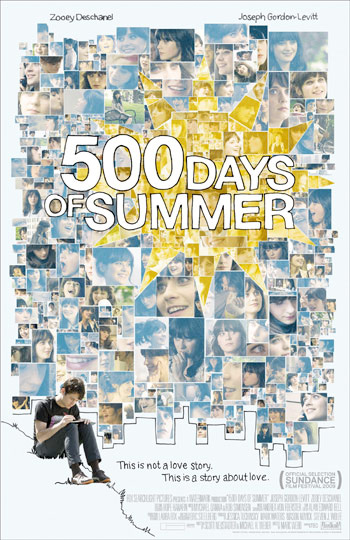
Review: 500 Days of Summer

To preface this review I believe it is of note that this is a movie that for various reasons I was highly interested in prior to its release. With this in mind, my first viewing of the movie was highly influenced by copious amounts of knowledge garnered both from interviews with the director and the cast, as well as numerous reviews from across the country. I must confess that with my head so packed with preconceived notions and perceptions, I feel another viewing is in order to fully appreciate the movie as a cohesive whole. With all of this in mind I will use the first half of this review to compare and contrast this movie with one of its predecessors and influences; Annie Hall. Due diligence and a genuine curiosity lead me to investigate the film before seeing 500 Days of Summer. Annie Hall is widely considered Woody Allen's best picture; a claim that until recently I was unable to verify. It seems sometimes popular opinion is correct as Annie Hall is at once a surprisingly timeless examination of human relationships, as well as a clever spin on a not-so-romantic comedy. This genre is not one that pops up too often in popular cinema for either the reasons that audiences are assumed incapable of tolerating anything short of a perfect ending, or an unenviable balance of humor and reality that may very well be tough to capture.

500 Days of Summer and Annie Hall share many things in common. For one, the films both begin with the admission that the focal relationships in question are unequivocally over and the male component is already on the other side. Each movie uses a fractured timeline in its conveyance of the emotion of a relationship, which is to say neither follows a primarily linear path. 500 Days of Summer uses the technique in a much more mannered way, informing the audience of the exact day (of 500) in which we find main character, Tom (Joseph Gordon-Levitt). Woody Allen in Annie Hall uses quick, jarring cuts to and fro throughout the relationship chiefly to juxtapose a moment either in the past or the future that is especially ironic when viewed next to an opposite from another time. There are many scenes in 500 Days of Summer that call back almost exactly to moments of Annie Hall. Specifically, a scene in which split screen is used to show Tom's expectations of a night at a party to the reality of how it actually happens. Webb noted that this scene in particular was a more modern spin on a scene in Hall when a conversation between Diane Keaton and Woody Allen is subtitled to juxtapose what the characters are saying with what they are thinking. If anything can be said about these two films as far as my comparisons are going, it's that one precludes the other and each attempts to reach the same endpoint via different means.

So, heaping these kinds of connections between a fairly new independent film and what is considered by many to be a classic film could be construed as being premature. In truth, when examining the subject matter in both films (that of a relationship that seems like everything and becomes nothing just as quickly with little reasoning) I find that both work in tandem towards similar interests. This is not to say the films are complimentary, or in some cases, even comparable. Simply the two take similar journeys and end up with different theses on the same subject. So what are the differences?

For one, 500 Days of Summer is much more concerned with cinematic style than Woody Allen's Oscar winning film, but not to the detriment of its story. 500 Days is told through music and bold camera work. In many ways its soundtrack is analogous to the way the current generation copes with many of the various foibles of life and love (that is to say, through music). It helps that said soundtrack is for the most part pitch perfect. A collection of offbeat, lesser known indie tracks perfectly supplements the moods Gordon-Levitt traverses throughout the film. This movie also employs an interesting twist on genre convention, focusing primarily on the male perspective in the story as well as putting said gentleman in the saddle of the hopeless romantic. It's basic role reversal, but it feels extremely fresh in this instance as movies rarely explore this interesting but no less real dynamic. Less of a romantic comedy and more of a coming-of-age tale, 500 Days of Summer deals with the realization that things like fate and destiny rarely align the stars in the ways we would like, and how naivety on this part can be the distinction between being a child or accepting adulthood. It warns of the danger of turning people into ideals, but does not abandon the audience completely to cynicism. Reassuringly, the film portends that ideals can be met with effort, or a lack of fear of putting oneself 'out there'. It never compromises on the hurt and pain of love and how it feels to lose it, but it's willing to offer a glimmer of hope with a wink to the audience before the final credits.

The setting of 500 Days is also unique in a few ways. For one, the director and cinematographer went to great lengths to capture the beauty of lesser known parts of LA. By doing so, Tom and Summer inhabit an almost postcard-world filled with vibrant colors and unreal focus. This elevates the narrative to an almost super-reality which is quite nicely anchored by some truly real emotional beats played out between the main characters. More than once while viewing this film I was struck by how accurate and real the interactions on screen were to life. Sure, this movie was taking place in an idealized setting, but the humans in it carry a certain reality and honesty I am hard pressed to identify in many other recent films of this nature. This is perhaps the film's greatest strength, and it allows the movie to play out in a way that is at once evocative visually of the way being in a relationship sometimes feels, while at the same time genuinely hitting these moments on a very personal level. These elements going hand in hand so well is something of a miracle, and it adds in spades to the charm of this story.

In the end, 500 Days of Summer is more an examination of what it means to grow up when something as tumultuous as love is the catalyst than it is of romance. It is a film of sometimes brutal honesty and tender humor that aims to almost empathize with the audience in shared misery, while at the same time trying earnestly to offer the hope that the world isn't as bleak as it can seem through the lens of our perceptions. It falls victim to one to three pitfalls of 'indie' movie making, but for the most part 500 Days of Summer is a challenging film that is not afraid to be honest about the harshness of life and love but will good-heartedly chuckle at it too.

Sunday, July 19, 2009

Review: Harry Potter and the Half-Blood Prince

DISCLAIMER: There are spoilers about the movie and the book in here that also may allude to some of the events of the final book. If you don't want to have even a hint of what's going to happen in the final book, you could probably read the first and last paragraphs and be satisfied.

If there were ever a series short of Lord of the Rings that desperately needed an extended edition when it hit DVD, it would be Harry Potter. Having already started to noticeably chafe under the time constraints of the last two installments, Half-Blood Prince feels like its fingers are brushing greatness and just missing by that much. It's a real shame because this movie more than many of the others before it treads new ground. For once the romantic interactions with the young cast feel real and genuine, unlike the stilted and forced scenes in Goblet of Fire's Triwizard Ball scenes. Unfortunately, these scenes are too few and far between in the course of this overstuffed movie.

Anyone who has read the books knows that Half-Blood Prince deals with a lot plot lines running almost on opposite ends of the spectrum from each other. The movie adaptation attempts to find the most common threads between the important elements and weave them into a nearly three hour movie. To some degrees the formula works, and when it does the movie fires in a way that its predecessors only hinted at. Sadly, for as much as it really clicks, the movie also fizzles at times as certain story beats just aren't played as dramatically as they should have been. For one, the eponymous 'Half-Blood Prince'; an element that by all rights should be front and center, meanders lifelessly in the peripheral of the film. By its portrayal here, one unfamiliar with the books or simply inattentive could not be blamed for wondering why the movie is titled such. Harry's scholastic success of direct consequence to the 'Prince' present in the novel is almost completely gone from the film. Much of the impact, especially that in the final moments of the film, is drained from the cinematic interpretation because of this omission. Besides the oversight of attention to the film's title, the movie never has enough time to explore any of the interesting things happening in its story. The book was bolstered handsomely by the budding relationship between Harry and Dumbledore as they struggled to crack the mystery of Voldemort's ultimate plans, and this was a thread that displayed prominently in the book serving as its spine. Besides the final half an hour of the movie and some early dialogue between the characters, you never get the impression of the respect and admiration the two share in the book.

Ron's Quidditch exploits only get a few minutes of screen time which is understandable. Less forgivable is the fact that after the one scene, we never even hear mention of his further successes that more or less defined Ron for me in the novel. I was also a bit disappointed with the fact that Alan Rickman opted to play Severus Snape a little less ambiguous than I felt he should have been. In the book version, you never really have an idea of what he's up to. Meanwhile from the early moments of the film while he takes the Unbreakable Vow, Rickman plays a not-too-subtle hesitance on his face which gives away his true motives to anyone looking close enough to notice.

Finally we have the issue of characterization; in this case most importantly of our main hero Harry Potter. In the book version of Half-Blood Prince the reader really feels the pressures dumped on Harry to not only solve a mystery that is WAY beyond his abilities at his age, but how in over his head he is when you consider that he now knows that he is the only one who can topple the nefarious Dark Lord. The success in the writing is that Harry also realizes this very thing and it builds his character. He takes on much more responsibility and grows more mature for it, if not in skill than in understanding. When the final moments of the book transpire, we actually believe him when he states he's not coming back to Hogwarts and that he fully intends to finish the work he and Dumbledore began. It's a shame that Daniel Radcliffe's Harry never conveys the fact that his life is fundamentally changing in ways it never has in years passed in the film. For all the strife and frustration Radcliffe is capable of emoting, it still feels like the film Harry Potter is simply reacting to the things happening to him instead of really experiencing them. It's hard to know if this fault comes down to Radcliffe or if the confines of the movie and its limits prevented him from really exploring the real alterations ravaging his character. Whenever he acknowledges the prophecy, you don't get the sense that this is a seventeen year old boy who somehow must figure out how to kill the most powerful evil in his world or how he's dealing with it.

Finally, I would like to mention my displeasure with the last act of the film. In the book, we are treated to an emotionally exhausting scene in which Dumbledore suffers greatly to retrieve what Harry and he believe is a Horcrux. This of course leaves the Professor near death with fatigue and when Harry returns them to Hogsmeade we are jolted by the appearance of the Dark Mark above Hogwarts and the success of Draco's mission. From here we get a much more intense encounter than that in the movie in which a helpless (petrified) Harry must watch Draco disarm a weakened Dumbledore and a seemingly heartless Snape kill him without a second thought. From here is described a magnificent battle between the Death Eaters and the Order of the Phoenix wherein the castle is torn apart. This is a crucial scene to the book and the overarching story because innocence is truly lost. Hogwarts for six books had been the safe zone of the story in which nothing disastrous could happen, and in one chapter it becomes as dangerous if not moreso than anywhere else in the wizarding world. It's jarring and it makes the reader feel the desperation and hopelessness of Harry as he chases Snape and is overpowered easily as an afterthought. In the film the whole scene plays much different. Besides Harry and a random guard-wizard, it would seem that no one in the castle had any idea that anything horrible had happened inside. In fact, the Death Eaters simply vandalize the castle before leaving and lighting Hagrid's hut on fire. There's no menace, there's no feeling of hopelessness, and the movie ends on a note of anticipation for the next installment instead of the emotionally spent and lost one of the novel. Sure, the book ended with Harry's vow to finish everything and not return to school, but there was a sense of finality to the proceedings because everything was different now. As far as the movie is concerned, this was just one more unfortunate incident in a line of incidents. I couldn't help but feel cheated by these moments I had so anticipated since first reading the book.

While this review went to great lengths to detail what I had issue with in this movie, I would be lying if I didn't outright say this is probably the second best HP film in the series. By at least having brushes with some real character moments and just glancing some of the epic moments from the book, this film does wonders in building suspense for the final confrontation awaiting in the final two movies. Unfortunately instead of wondering how this fairly average boy is going to ever stop all these bad things, the audience is left certain of his success just lacking the way it all will transpire. Overall I would suggest see Harry Potter and the Half-Blood Prince, but if you feel intrigued at all by the events on screen head out immediately and pick up the book. You won't be disappointed either way.